
|
You entered: ring galaxy
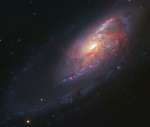 The Arms of M106
6.02.2013
The spiral arms of bright galaxy M106 sprawl through this remarkable multiframe portrait, composed of data from ground- and space-based telescopes. Also known as NGC 4258, M106 can be found toward the northern constellation Canes Venatici. The well-measured distance to M106 is 23.5 million light-years, making this cosmic scene about 80,000 light-years across.
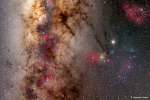 A Scorpius Sky Spectacular
6.04.2019
If Scorpius looked this good to the unaided eye, humans might remember it better. Scorpius more typically appears as a few bright stars in a well-known but rarely pointed out zodiacal constellation. To get a spectacular image like this, though, one needs a good camera, color filters, and a digital image processor.
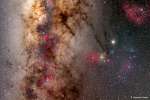 A Scorpius Sky Spectacular
4.05.2014
If Scorpius looked this good to the unaided eye, humans might remember it better. Scorpius more typically appears as a few bright stars in a well-known but rarely pointed out zodiacal constellation. To get a spectacular image like this, though, one needs a good camera, color filters, and a digital image processor.
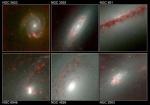 An Infrared Galaxy Gallery
21.03.1999
Where do stars form in galaxies? One way to find this out it to look for glowing hydrogen, a material common to hot star-forming regions. To find large areas of glowing hydrogen, the Hubble Space Telescope's NICMOS instrument surveyed about 100 nearby spiral galaxies.
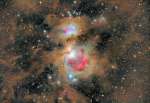 Dust of the Orion Nebula
6.02.2012
What surrounds a hotbed of star formation? In the case of the Orion Nebula -- dust. The entire Orion field, located about 1600 light years away, is inundated with intricate and picturesque filaments of dust.
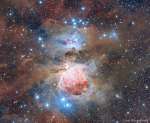 Dust of the Orion Nebula
28.12.2015
What surrounds a hotbed of star formation? In the case of the Orion Nebula -- dust. The entire Orion field, located about 1600 light years away, is inundated with intricate and picturesque filaments of dust.
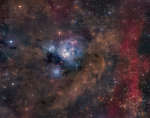 Young Suns of NGC 7129
15.10.2025
Young suns still lie within dusty NGC 7129, some 3,000 light-years away toward the royal constellation Cepheus. While these stars are at a relatively tender age, only a few million years old, it is likely that our own Sun formed in a similar stellar nursery around five billion years ago.
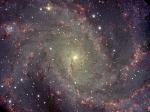 NGC 6946: The Fireworks Galaxy
24.01.2005
Why is this galaxy so active? Nearby spiral galaxy NGC 6946 is undergoing a tremendous burst of star formation with no obvious cause. In many cases spirals light up when interacting with another galaxy, but NGC 6946 appears relatively isolated in space.
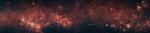 GLIMPSE the Milky Way
15.12.2005
Scroll right and gaze through the dusty plane of our Milky Way Galaxy in infrared light. The cosmic panorama is courtesy of the Galactic Legacy Infrared Mid-Plane Survey Extraordinaire (GLIMPSE) project and the Spitzer Space Telescope.
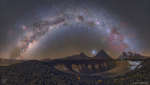 Milky Way over Chilean Volcanoes
20.08.2017
Sometimes, the sky mimics the ground. Taken in 2017 May from the Atacama Desert in Chile, the foreground of the featured image encompasses the dipping edge of the caldera of an extinct volcano. Poetically echoing the dip below is the arch of our Milky Way Galaxy above.
|
January February March April May June July August September October |
|||||||||||||||||||||||||||||||||||||||||||||||||