
|
You entered: spiral arms
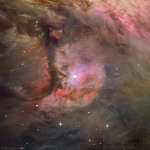 M43: Dust, Gas, and Stars in the Orion Nebula
6.07.2020
Unspeakable beauty and unimaginable bedlam can be found together in the Orion Nebula Arguably the most famous of all astronomy nebulas, the Great Nebula in Orion is an immense interstellar molecular cloud only 1500 light-years away.
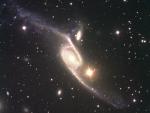 NGC 6872: A Stretched Spiral
25.05.1999
What makes NGC 6872 so long? Measuring over 700,000 light years across from top to bottom, NGC 6872 is one of the largest barred spiral galaxies known. The galaxy's elongated shape might have something to do with its continuing collision with the smaller galaxy IC 4970, visible just above center.
 A Flock of Stars
5.10.2001
Only a few stars can be found within ten light-years of our lonely Sun, situated near an outer spiral arm of the Milky Way galaxy. But if our Sun were found within a star cluster, thousands of stars might occupy a similar space.
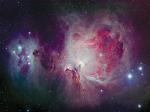 The Great Nebula in Orion
27.09.2004
The Great Nebula in Orion is a colorful place. Visible to the unaided eye, it appears as a small fuzzy patch in the constellation of Orion. Long exposure, digitally sharpened images like this, however, show the Orion Nebula to be a busy neighborhood of young stars, hot gas, and dark dust.
 A Flock of Stars
6.09.2008
Only a few stars can be found within ten light-years of our lonely Sun, situated near an outer spiral arm of the Milky Way galaxy. But if the Sun were found within one of our galaxy's star clusters, thousands of stars might occupy a similar space.
 A Flock of Stars
13.12.2003
Only a few stars can be found within ten light-years of our lonely Sun, situated near an outer spiral arm of the Milky Way galaxy. But if the Sun were found within one of our galaxy's star clusters, thousands of stars might occupy a similar space.
 IC 1805: The Heart Nebula
4.03.2013
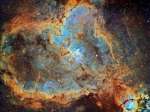
Sprawling across almost 200 light-years, emission nebula IC 1805 is a mix of glowing interstellar gas and dark dust clouds. Derived from its Valentine's-Day-approved shape, its nickname is the Heart Nebula. About 7,500 light-years away in the Perseus spiral arm of our galaxy, stars were born in IC 1805.
 IC 1805: The Heart Nebula
14.02.2009
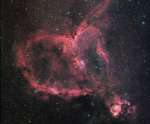
Sprawling across almost 200 light-years, emission nebula IC 1805 is a mix of glowing interstellar gas and dark dust clouds. Derived from its Valentine's-Day-approved shape, its nickname is the Heart Nebula. About 7,500 light-years away in the Perseus spiral arm of our galaxy, stars were born in IC 1805.
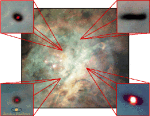 Planetary Systems Now Forming in Orion
7.12.1996
How do planets form? Astronomers are finding out by studying one of the most interesting of all astronomical nebulae known, the Great Nebula in Orion. Insets to above mosaic show several planetary systems in formation. The bottom left insert shows the relative size of our own Solar System. The Orion Nebula contains many stellar nurseries.
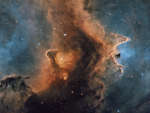 IC 1871: Inside the Soul Nebula
29.10.2015
This cosmic close-up looks deep inside the Soul Nebula. The dark and brooding dust clouds outlined by bright ridges of glowing gas are cataloged as IC 1871. About 25 light-years across, the telescopic field of view spans only a small part of the much larger Heart and Soul nebulae.
|
January February March April May June July August September |
|||||||||||||||||||||||||||||||||||||||||||||||||