
|
You entered: wind
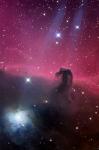 Reflections on the Horsehead Nebula
30.11.2005
Sculpted by stellar winds and radiation, a magnificent interstellar dust cloud by chance has assumed this recognizable shape. Fittingly named the Horsehead Nebula, it is some 1,500 light-years distant, embedded in the vast Orion cloud complex.
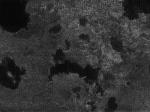 Possible Methane Lakes on Titan
31.07.2006
Have methane lakes been discovered on Saturn's Titan? That exciting possibility was uncovered from analyses of radar images returned last week by the robotic Cassini spacecraft now orbiting Saturn. The above image is a radar reflection from terrain near Titan's North Pole and spans a region about 200 kilometers across.
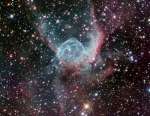 Thor s Emerald Helmet
17.01.2008
This helmet-shaped cosmic cloud with wing-like appendages is popularly called Thor's Helmet. Heroically sized even for a Norse god, Thor's Helmet is about 30 light-years across. In fact, the helmet is actually...
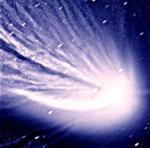 Detailing Hale-Bopp
8.05.1997
This enhanced composite image detailing structure in the coma and dust tail of Hale-Bopp was recorded May 5 - one day before the comet's passage from north to south across the plane of Earth's orbit.
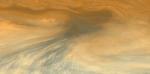 Jupiter's Dry Spots
12.06.1997
Known for its spectacular images of Jupiter's moons, Io, Ganymede, Callisto, and Europa, the robot spacecraft Galileo has also aggressively explored the Jovian atmosphere. In December of 1995, Galileo's atmospheric probe descended into Jupiter's clouds and reported a surprising absence of water.
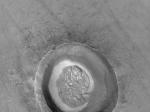 Brain Crater on Mars
19.05.2004
What caused this unusual looking crater floor on Mars? Appearing at first glance to resemble the human brain, the natural phenomena that created the unusual texture on the floor of this Martian impact crater are currently under investigation. The light colored region surrounding the brain-textured region is likely sand dunes sculpted by winds.
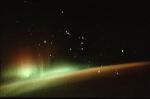 Aurora and Orion
20.03.1999
Looking toward the south from low Earth orbit, the crew of the Space Shuttle Endeavor made this stunning time exposure of the Aurora Australis or southern lights in April of 1994. Aurora are visible at high northern latitudes as well, with the northern lights known as Aurora Borealis.
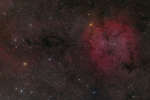 IC 1396 and Surrounding Starfield
19.08.2009
Sprawling across hundreds of light-years, emission nebula IC 1396, visible on the upper right, mixes glowing cosmic gas and dark dust clouds. Stars are forming in this area, only about 3,000 light-years from Earth. This wide angle view also captures surrounding emission and absorption nebula.
 Stardust in Perseus
4.02.2010
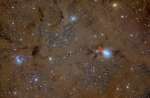
This cosmic expanse of dust, gas, and stars covers close to 3 degrees on the sky in the heroic constellation Perseus. Right of center in the gorgeous skyscape is the dusty blue reflection nebula NGC 1333, about 1,000 light-years away. At that estimated distance, the field of view is about 50 light-years across.
 The Wide and Deep Lagoon
9.09.2016
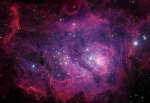
Ridges of glowing interstellar gas and dark dust clouds inhabit the turbulent, cosmic depths of the Lagoon Nebula. Also known as M8, the bright star forming region is about 5,000 light-years distant.
|
January February March April May June July August September October |
|||||||||||||||||||||||||||||||||||||||||||||||||