
|
You entered: young stars
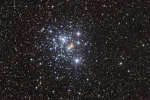 NGC 4755: A Jewel Box of Stars
17.08.2010
The great variety of star colors in this open cluster underlies its name: The Jewel Box. One of the bright central stars is a red supergiant, in contrast to the many blue stars that surround it. The cluster, also known as Kappa Crucis contains just over 100 stars, and is about 10 million years old.
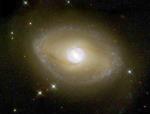 The Galactic Ring of NGC 6782
20.11.2001
Do spiral galaxies look the same in every color? NGC 6782 demonstrates colorfully that they do not. In visible light, NGC 6782 appears to be a normal spiral galaxy with a bright bar across its center.
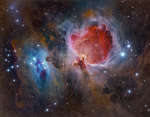 Great Orion Nebulae
13.09.2011
The Great Nebula in Orion, also known as M42, is one of the most famous nebulas in the sky. The star forming region's glowing gas clouds and hot young stars...
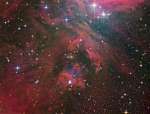 South of Orion
3.04.2008
This tantalizing array of nebulae and stars can be found about 2 degrees south of the famous star-forming Orion Nebula. The region abounds with energetic young stars producing jets and outflows that push through the surrounding material at speeds of hundreds of kilometers per second.
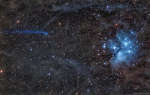 Blue Comet Meets Blue Stars
11.02.2018
What's that heading for the Pleiades star cluster? It appears to be Comet C/2016 R2 (PanSTARRS), but here, appearances are deceiving. On the right and far in the background, the famous Pleiades star cluster is dominated by blue light from massive young stars.
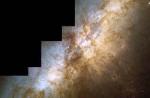 M82 After the Crash
11.03.2001
When did the Cigar Galaxy light up? Evidence indicates how M82, the Cigar Galaxy, became so bright and peculiar: it collided with neighboring galaxy M81. Astronomers become detectives, however, when trying to figure out when this collision occurred.
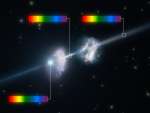 Caught in the Afterglow
24.11.2011
In this artist's illustration, two distant galaxies formed about 2 billion years after the big bang are caught in the afterglow of GRB090323, a gamma-ray burst seen across the Universe. Shining through...
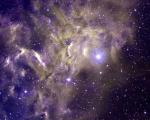 AE Aurigae: The Flaming Star
3.12.2001
Is star AE Aurigae on fire? Although surrounded by what may look like smoke, the object known as the "flaming star" creates energy primarily by nuclear fusion, like other stars. Fire, typically defined...
 N11: Star Clouds of the LMC
11.02.2013
Massive stars, abrasive winds, mountains of dust, and energetic light sculpt one of the largest and most picturesque regions of star formation in the Local Group of Galaxies. Known as N11, the region...
 Great Orion Nebulae
23.10.2008
The Great Nebula in Orion, also known as M42, is one of the most famous nebulae in the sky. The star forming region's glowing gas clouds and hot young stars...
|
January February March April May June July August September October |
|||||||||||||||||||||||||||||||||||||||||||||||||