
|
You entered: image
 APOD: 2025 July 8 Б The Pleiades in Red and Blue
8.07.2025
If you have looked at the sky and seen a group of stars about the size of the full Moon, that's the Pleiades (M45). Perhaps the most famous star cluster in the sky, its brightest stars can be seen even from the light-polluted cities.
 APOD: 2025 December 15 Б Gemini Meteors over Snow Capped Mountains
15.12.2025
Where are all of these meteors coming from? In terms of direction on the sky, the pointed answer is the constellation of Gemini. That is why the major meteor shower in December is known as the Geminids -- because shower meteors all appear to come from a radiant toward Gemini.
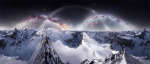 APOD: 2026 April 21 Б Three Sky Arches over Snowy Alps
21.04.2026
Why are there three arches across the sky instead of two? Last month, after being dropped off by a helicopter at a high mountain peak in the Alps near the Swiss Italian border, an adventurous astrophotographer expected two arches of our Milky Way galaxy to be visible during the night.
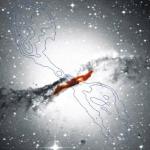 Centaurus A: The Galaxy Deep Inside
2.02.2002
Deep inside Centaurus A, the closest active galaxy to Earth, lies ... another galaxy! Cen A is a giant elliptical galaxy a mere 10 million light-years distant with a central jumble of stars, dust, and gas that probably hides a massive black hole.
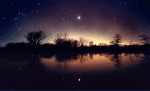 Hyakutake, Venus, Orion, and Pond
18.04.1996
Can you find Comet Hyakutake in the above picture? In this gorgeous photo, the starry night sky of April 9th is pictured with its new comet visitor. In the foreground is a pond with the lights of Kansas City, Missouri on the western horizon. On the upper left, the constellation of Orion is visible.
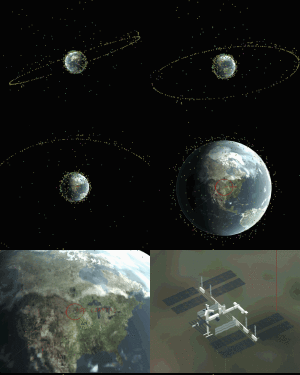 The Satellites that Surround Earth
14.07.2003
Thousands of satellites orbit the Earth. Costing billions of dollars, this swarm of high altitude robots is now vital to communication, orientation, and imaging both Earth and space. One common type of orbit is geostationary where a satellite will appear to hover above one point on Earth's equator.
 Dark Matter Map
14.08.2003
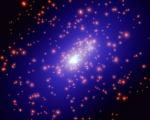
The total mass within giant galaxy cluster CL0025+1654, about 4.5 billion light-years away, produces a cosmic gravitational lens -- bending light as predicted by Einstein's theory of gravity and forming detectable images of even more distant background galaxies.
 Reflections on the 1970s
2.10.2003
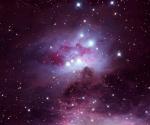
The 1970s are often overlooked. In particular, the beautiful grouping of reflection nebulae NGC 1977, NGC 1975, and NGC 1973 in Orion are often overlooked in favor of the substantial stellar nursery better known as the Orion Nebula.
 Arp 81: 100 Million Years Later
11.12.2003
From planet Earth, we view this strongly interacting pair of galaxies, cataloged as Arp 81, as they were only about 100 million years after their mutual closest approach. The havoc wreaked by gravity during...
 NGC 2266: Old Cluster in the New General Catalog
29.04.1999
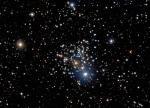
The New General Catalog of star clusters and nebulae really isn't so new. In fact, it was published in 1888 - an attempt by J. L. E. Dreyer to consolidate the work of astronomers William, Caroline, and John Herschel along with others into a useful single, complete catalog of astronomical discoveries and measurements.
|
January February March April May June July August September |
|||||||||||||||||||||||||||||||||||||||||||||||||