
|
You entered: Earth
 Sentinels of the Arctic
12.04.2015
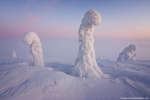
Who guards the north? Judging from the above photograph, possibly giant trees covered in snow and ice. The featured picture was taken a few winters ago in Finnish Lapland where weather can include sub-freezing temperatures and driving snow.
 ISS Over Mont Megantic Observatory
18.08.2007
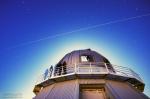
On August 1st, a time exposure created this surreal view that looks up into the early morning sky over southern Quebec. Only the light from a nearly Full Moon brightens the sky and highlights the dome of the 1.6 meter telescope at Mont-Megantic Observatory.
 Circle Around the Moon
13.02.2009
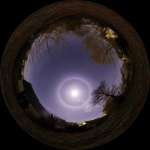
If your sister-in-law phoned you at 1am to tell you there was a circle around the Moon, how would you react? When it happened to him early last Sunday morning, photographer Laurent Laveder, grabbed his equipment and ran outside!
 Moon Over Haleakala
10.06.2006
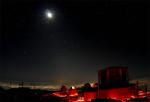
A waxing crescent Moon shines over the caldera of dormant volcano Haleakala and observatory domes in this dramatic view from above the clouds. Looking west from Maui, Hawaii on May 31st, the scene also records the lights of Honolulu on the horizon.
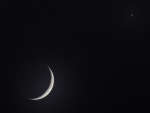 Crescent Moon and Venus
6.03.2009
Last Friday, the Moon and Venus shared the early evening sky in a beautiful conjunction. Separated by only about 2 degrees, they also were both in a crescent phase. Just like our Moon, Venus can appear as a full disk or a thin crescent.
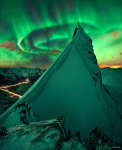 In Green Company: Aurora over Norway
2.11.2014
Raise your arms if you see an aurora. With those instructions, two nights went by with, well, clouds -- mostly. On the third night of returning to same peaks, though, the sky not only cleared up but lit up with a spectacular auroral display.
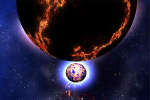 On the Origin of Gold
11.09.2011
Where did the gold in your jewelry originate? No one is completely sure. The relative average abundance in our Solar System appears higher than can be made in the early universe, in stars, and even in typical supernova explosions.
 Sentinels of the Arctic
29.05.2012
Who guards the north? Judging from the above photograph, possibly giant trees covered in snow and ice. The picture was taken last winter in Finnish Lapland where weather can include sub-freezing temperatures and driving snow. Surreal landscapes sometimes result, where common trees become cloaked in white and so appear, to some, as watchful aliens.
 A Five Planet Dawn
30.01.2016
As January closes and in the coming days of February, early morning risers can spot the five naked-eye planets before dawn. Though some might claim to see six planets, in this seaside panoramic view all five celestial wanderers were found above the horizon along with a bright waning gibbous Moon on January 27.
 The Iron Moon
1.06.1996
In March and April of 1994 the unmanned Clementine spacecraft demonstrated the technique of prospecting on the Moon from lunar orbit. To accomplish this, Clementine turned an array of cameras sensitive to ultraviolet-visible and near-infrared light toward the lunar surface, producing the first broad-spectrum global imaging of the moon.
|
January February March April May June July August September October |
|||||||||||||||||||||||||||||||||||||||||||||||||