
|
You entered: stars
 Running Messier s Marathon
19.04.2008
Gripped by an astronomical spring fever, many northern hemisphere stargazers embark on a Messier Marathon. Completing the marathon requires viewing all 110 objects in 18th century French astronomer Charles Messier's catalog in one glorious dusk-to-dawn observing run.
 Equinox and the Iron Sun
23.09.2010
Today, the Sun crosses the celestial equator heading south at 03:09 Universal Time. Known as an equinox, this astronomical event marks the first day of autumn in the northern hemisphere and spring in the south. Equinox means equal night.
 Atoms for Peace Galaxy Collision
16.11.2010
Is this what will become of our Milky Way Galaxy? Perhaps if we collide with the Andromeda Galaxy in a few billion years, it might. Pictured above is NGC 7252, a jumble of stars created by a huge collision between two large galaxies.
 NGC 2736: The Pencil Nebula
24.09.2012
This shock wave plows through space at over 500,000 kilometers per hour. Moving toward to bottom of this beautifully detailed color composite, the thin, braided filaments are actually long ripples in a sheet of glowing gas seen almost edge on. Cataloged as NGC 2736, its narrow appearance suggests its popular name, the Pencil Nebula.
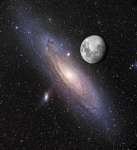 Moon Over Andromeda
1.08.2013
The Great Spiral Galaxy in Andromeda (aka M31), a mere 2.5 million light-years distant, is the closest large spiral to our own Milky Way. Andromeda is visible to the unaided eye as a small...
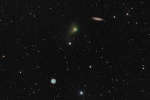 The Comet, the Owl, and the Galaxy
21.04.2016
Comet C/2014 S2 (PanSTARRS) poses for a Messier moment in this telescopic snapshot from April 18. In fact it shares the 1.5 degree wide field-of-view with two well-known entries in the 18th century comet-hunting astronomer's famous catalog.
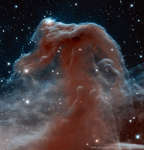 The Horsehead Nebula in Infrared from Hubble
8.06.2016
While drifting through the cosmos, a magnificent interstellar dust cloud became sculpted by stellar winds and radiation to assume a recognizable shape. Fittingly named the Horsehead Nebula, it is embedded in the vast and complex Orion Nebula (M42).
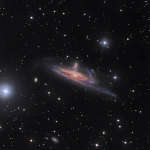 Galaxies in the River
8.01.2020
Large galaxies grow by eating small ones. Even our own galaxy engages in a sort of galactic cannibalism, absorbing small galaxies that are too close and are captured by the Milky Way's gravity.
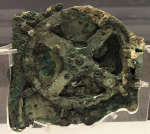 The Antikythera Mechanism
21.03.2021
No one knew that 2,000 years ago, the technology existed to build such a device. The Antikythera mechanism, pictured, is now widely regarded as the first computer. Found at the bottom...
 Comet Leonard from Space
15.12.2021
What does Comet Leonard look like from space? Today's featured image from Origin.Space's Yangwang-1 space telescope shows not only the currently bright comet -- but several other space delights as well. Taken...
|
January February March April May June July August September October |
|||||||||||||||||||||||||||||||||||||||||||||||||