
|
You entered: Earth orbit
 A Mercury Transit Sequence
4.05.2016
This coming Monday, Mercury will cross the face of the Sun, as seen from Earth. Called a transit, the last time this happened was in 2006. Because the plane of Mercury's orbit is not exactly coincident with the plane of Earth's orbit, Mercury usually appears to pass over or under the Sun.
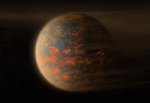 Cancri 55 e: Climate Patterns on a Lava World
5.04.2016
Why might you want to visit super-earth Cancri 55 e? Its extremely hot climate would be a deterrent, as mornings on this world might bring fresh lava flows. Discovered in 2004, the planet Cancri 55 e has twice the diameter of our Earth and about 10 times Earth's mass.
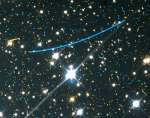 Asteroids in the Distance
10.02.2013
Rocks from space hit Earth every day. The larger the rock, though, the less often Earth is struck. Many kilograms of space dust pitter to Earth daily. Larger bits appear initially as a bright meteor. Baseball-sized rocks and ice-balls streak through our atmosphere daily, most evaporating quickly to nothing.
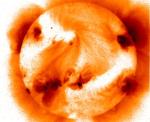 Perihelion Sun
11.01.1999
The Earth's orbit is not a perfect, sun-centered circle. At aphelion, the most distant point in Earth's orbit, the Sun is 150 million kilometers away and at perihelion, the closest point, Earth approaches the Sun to within about 147 million kilometers. While aphelion occurs in July, perihelion for planet Earth comes in January.
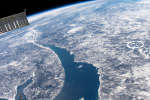 APOD: 2025 October 11 Б Manicouagan Impact Crater from Space
11.10.2025
Orbiting 400 kilometers above Quebec, Canada, planet Earth, the International Space Station Expedition 59 crew captured this snapshot of the broad St. Lawrence River and curiously circular Lake Manicouagan on April 11, 2019. Right of center, the ring-shaped lake is a modern reservoir within the eroded remnant of an ancient 100 kilometer diameter impact crater.
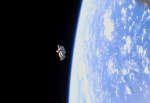 SuitSat1: A Spacesuit Floats Free
27.04.2014
A spacesuit floated away from the International Space Station eight years ago, but no investigation was conducted. Everyone knew that it pushed by the space station crew. Dubbed Suitsat-1, the unneeded Russian Orlan spacesuit filled mostly with old clothes was fitted with a faint radio transmitter and released to orbit the Earth.
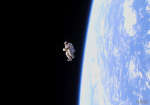 SuitSat 1: A Spacesuit Floats Free
28.03.2021
A spacesuit floated away from the International Space Station 15 years ago, but no investigation was conducted. Everyone knew that it was pushed by the space station crew. Dubbed Suitsat-1, the unneeded Russian Orlan spacesuit filled mostly with old clothes was fitted with a faint radio transmitter and released to orbit the Earth.
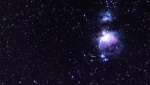 Geostationary Highway through Orion
16.01.2017
Put a satellite in a circular orbit about 42,000 kilometers from the center of the Earth and it will orbit once in 24 hours. Because that matches Earth's rotation period, it is known as a geosynchronous orbit.
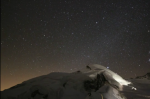 Geostationary Satellites Beyond the Alps
11.04.2012
Why don't those stars move? Stars in the sky will typically appear to rise and set as the Earth turns. Those far to the north or south will appear to circle the pole. If you look closely at the above time-lapse movie, however, there are points of light that appear stationary.
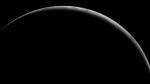 A Crescent Earth at Midnight
21.06.2003
The Earth's northern hemisphere is outlined as a sunlit crescent in this dramatic view from orbit, recorded near local midnight by the Geostationary Operational Environmental Satellite (GOES-8) on June 22, 1996. That...
|
January February March April May June July August September October |
|||||||||||||||||||||||||||||||||||||||||||||||||