
|
You entered: FUSE
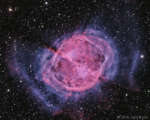 M27: The Dumbbell Nebula
2.11.2016
The first hint of what will become of our Sun was discovered inadvertently in 1764. At that time, Charles Messier was compiling a list of diffuse objects not to be confused with comets.
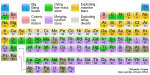 Where Your Elements Came From
24.10.2017
The hydrogen in your body, present in every molecule of water, came from the Big Bang. There are no other appreciable sources of hydrogen in the universe. The carbon in your body was made by nuclear fusion in the interior of stars, as was the oxygen.
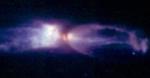 The Rotten Egg Planetary Nebula
1.11.1999
Not all evolving stars eject gas clouds that look like people. OH231.8+4.2 was a star much like our Sun that ran out of nuclear fuel to fuse in its core.
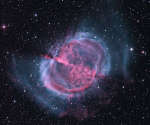 M27: The Dumbbell Nebula
14.09.2014
The first hint of what will become of our Sun was discovered inadvertently in 1764. At that time, Charles Messier was compiling a list of diffuse objects not to be confused with comets.
 APOD: 2023 January 8 Б Where Your Elements Came From
8.01.2023
The hydrogen in your body, present in every molecule of water, came from the Big Bang. There are no other appreciable sources of hydrogen in the universe. The carbon in your body was made by nuclear fusion in the interior of stars, as was the oxygen.
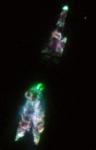 Emerging Planetary Nebula CRL 618
6.09.2000
CRL 618 may look to some like an Olympian declaring victory. Only a few hundred years ago, however, CRL 618 appeared as a relatively modest red giant star. Since then it has run out of core material to fuse and so has started to become a planetary nebula.
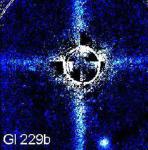 Brown Dwarf Gliese 229B
24.03.1999
The spot near the bottom is an image of an unusual type of object: a brown dwarf. A brown dwarf is sometimes called a "failed star" because it does not have enough mass to shine by nuclear fusion.
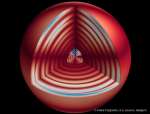 Echoes from the Depths of a Red Giant Star
8.04.2011
A journey to the center of a red giant star is very firmly in the realm of science fiction. But the science of asteroseismology can explore the conditions there. The technique is to time the small variations in a star's brightness measured by the planet hunting Kepler spacecraft.
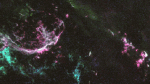 Supernova Remnant: Cooking Elements In The LMC
9.05.1996
Massive stars cook elements in their cores through nuclear fusion. Starting with the light elements of hydrogen and helium, their central temperatures and pressures produce progressively heavier elements, carbon, oxygen, nitrogen, etc. up through iron.
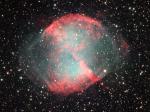 M27: The Dumbbell Nebula
3.06.2005
The first hint of what will become of our Sun was discovered inadvertently in 1764. At that time, Charles Messier was compiling a list of diffuse objects not to be confused with comets.
|
January February March April May June July August September |
|||||||||||||||||||||||||||||||||||||||||||||||||