
|
You entered: Flame nebula
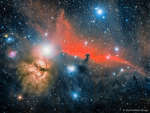 The Horsehead Nebula
16.12.2015
The Horsehead Nebula is one of the most famous nebulae on the sky. It is visible as the dark indentation to the red emission nebula in the center of the above photograph. The horse-head feature is dark because it is really an opaque dust cloud that lies in front of the bright red emission nebula.
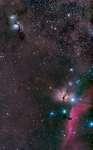 Orion s Belt Continued
11.02.2009
Yesterday's skyscape featured Alnitak, Alnilam, and Mintaka, the stars of Orion's Belt. Today's also presents the easternmost belt star, Alnitak, at the bottom right of the field, surrounded by the well-known Horsehead and Flame nebulae.
 Orion in Red and Blue
13.04.2016
When did Orion become so flashy? This colorful rendition of part of the constellation of Orion comes from red light emitted by hydrogen and sulfur (SII), and blue-green light emitted by oxygen (OIII). Hues...
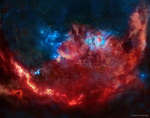 Orion in Red and Blue
14.10.2018
When did Orion become so flashy? This colorful rendition of part of the constellation of Orion comes from red light emitted by hydrogen and sulfur (SII), and blue-green light emitted by oxygen (OIII). Hues...
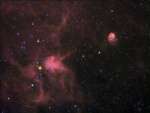 The Spider and the Fly
13.01.2010
Bright clusters and nebulae abound in the ancient northern constellation of Auriga. The region includes the open star cluster M38, emission nebula IC 410 with Tadpoles, Auriga's own Flaming Star Nebula IC 405, and this interesting pair IC 417 (lower left) and NGC 1931.
 Orions Belt and Sword over Teides Peak
28.03.2016
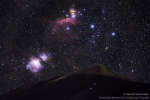
The southern part of Orion, the famous constellation and mythical hunter, appears quite picturesque posing here over a famous volcano. Located in the Canary Islands off the northwest coast of Africa, the snow-peaked Teide is one of the largest volcanoes on Earth.
 Barnards Loop around the Horsehead Nebula
24.02.2009
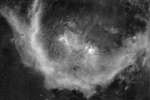
Why is the Horsehead Nebula surrounded by a bubble? Although hard to make out above, the famous Horsehead Nebula is the slight dark indentation in the bright streak just to the left of the image center. Glowing like an emission nebula, the origin of the bubble, known as Barnard's Loop, is currently unknown.
 Orion over Argentine Mountains
9.06.2020
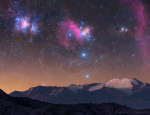
Do you recognize the constellation of Orion? It may be harder than usual in today's featured image because the camera has zoomed in on the center, and the exposure is long enough to enhance nebulas beyond what the unaided human eye can see.
 Barnards Loop around the Horsehead Nebula
17.04.2006
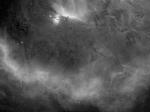
Why is the Horsehead Nebula surrounded by a bubble? Although glowing like an emission nebula, the origin of the bubble, known as Barnard's Loop, is currently unknown. Progenitor hypotheses include the winds from bright Orion stars and the supernovas of stars long gone.
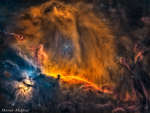 A Lion in Orion
7.03.2022
Yes, but can you see the lion? A deep exposure shows the famous dark indentation that looks like a horse's head, visible just left and below center, and known unsurprisingly as the Horsehead Nebula. The Horsehead Nebula (Barnard 33) is part of a vast complex of dark absorbing dust and bright glowing gas.
|
January February March April May June July August September October |
|||||||||||||||||||||||||||||||||||||||||||||||||