
|
You entered: Omega Centauri
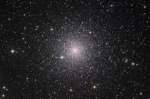 Globular Star Cluster NGC 6752
5.07.2013
Some 13,000 light-years away toward the southern constellation Pavo, the globular star cluster NGC 6752 roams the halo of our Milky Way galaxy. Over 10 billion years old, NGC 6752 follows clusters Omega Centauri and 47 Tucanae as the third brightest globular in planet Earth's night sky.
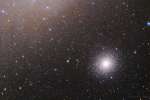 47 Tuc Near the Small Magellanic Cloud
6.12.2012
Globular star cluster 47 Tucanae is a jewel of the southern sky. Also known as NGC 104, it roams the halo of our Milky Way Galaxy along with around 200 other globular star clusters.
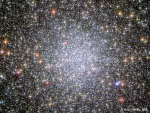 Globular Star Cluster 47 Tuc
18.05.2015
Globular star cluster 47 Tucanae is a jewel box of the southern sky. Also known as NGC 104, it roams the halo of our Milky Way Galaxy along with over 150 other globular star clusters.
 NGC 2419: Intergalactic Wanderer
12.04.2023
Stars of the globular cluster NGC 2419 are packed into this Hubble Space Telescope field of view toward the mostly stealthy constellation Lynx. The two brighter spiky stars near the edge of the frame are within our own galaxy. NGC 2419 itself is remote though, some 300,000 light-years away.
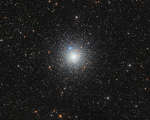 Globular Star Cluster NGC 6752
22.01.2020
Some 13,000 light-years away toward the southern constellation Pavo, the globular star cluster NGC 6752 roams the halo of our Milky Way galaxy. Over 10 billion years old, NGC 6752 follows clusters Omega Centauri and 47 Tucanae as the third brightest globular in planet Earth's night sky.
 Globular Star Cluster NGC 6752
24.10.2024
Some 13,000 light-years away toward the southern constellation Pavo, the globular star cluster NGC 6752 roams the halo of our Milky Way galaxy. Over 10 billion years old, NGC 6752 follows clusters Omega Centauri, 47 Tucanae, and Messier 22 as the fourth brightest globular in planet Earth's night sky.
|
January February March April May June July August September October |
|||||||||||||||||||||||||||||||||||||||||||||||||