
|
You entered: Voyager 2
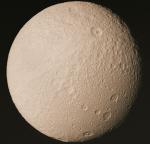 Saturns Moon Tethys
19.05.2002
Tethys is one of the larger and closer moons of Saturn. It was visited by both Voyager spacecraft - Voyager 1 in November 1980 and by Voyager 2 in August 1981. Tethys is now known to be composed almost completely of water ice. Tethys shows a large impact crater that nearly circles the planet.
 Milky Way Voyager
2.09.2017
Launched in 1977 on a tour of the outer planets of the Solar System, Voyager 1 and 2 have become the longest operating and most distant spacecraft from Earth. Nearly 16 light-hours from...
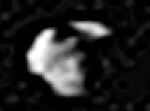 Dione's Lagrange Moon Helene
10.10.1995
Saturn's moon Helene is very unusual in that it circles Saturn near the orbit of a bigger moon: Dione. Helene is situated in what is called a "Lagrange point" of Dione - a place of stability created by Dione's gravity.
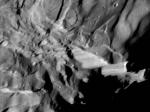 Verona Rupes: Tallest Known Cliff in the Solar System
23.07.2007
Could you survive a jump off the tallest cliff in the Solar System? Quite possibly. Verona Rupes on Uranus' moon Miranda is estimated to be 20 kilometers deep -- ten times the depth of the Earth's Grand Canyon.
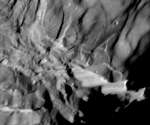 Verona Rupes: Tallest Known Cliff in the Solar System
4.04.2011
Could you survive a jump off the tallest cliff in the Solar System? Quite possibly. Verona Rupes on Uranus' moon Miranda is estimated to be 20 kilometers deep -- ten times the depth of the Earth's Grand Canyon.
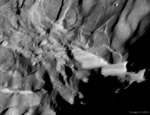 Verona Rupes: Tallest Known Cliff in the Solar System
27.11.2016
Could you survive a jump off the tallest cliff in the Solar System? Quite possibly. Verona Rupes on Uranus' moon Miranda is estimated to be 20 kilometers deep -- ten times the depth of the Earth's Grand Canyon.
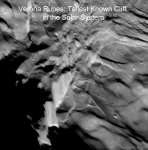 Verona Rupes: Tallest Known Cliff in the Solar System
29.11.2020
Could you survive a jump off the tallest cliff in the Solar System? Quite possibly. Verona Rupes on Uranus' moon Miranda is estimated to be 20 kilometers deep -- ten times the depth of the Earth's Grand Canyon.
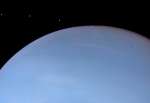 Despina, Moon of Neptune
3.09.2009
Despina is a tiny moon of Neptune. A mere 148 kilometers across, diminutive Despina was discovered in 1989, in images from the Voyager 2 spacecraft taken during its encounter with the solar system's most distant gas giant planet.
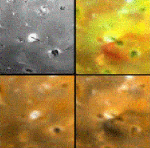 Volcano Euboea Fluctus On Io
8.09.1996
Jupiter's moon Io is turning out to be our Solar System's geologic powerhouse. The churning moon was photographed again just recently on June 27th and again shows signs of violent activity. Shown above are photographs of the volcano Euboea Fluctus taken at different times.
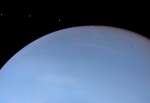 Despina, Moon of Neptune
16.01.2014
Despina is a tiny moon of Neptune. A mere 148 kilometers across, diminutive Despina was discovered in 1989, in images from the Voyager 2 spacecraft taken during its encounter with the solar system's most distant gas giant planet.
|
January February March April May June July August September |
|||||||||||||||||||||||||||||||||||||||||||||||||