
|
You entered: astronomy day
 APOD: 2025 June 2 Б Veil Nebula: Wisps of an Ancient Supernova
2.06.2025
Wisps like this are all that remain visible of a Milky Way star. About 7,000 years ago that star exploded in a supernova, leaving the Veil Nebula. At the time, the expanding cloud was likely as bright as a crescent Moon, remaining visible for weeks to people living at the dawn of recorded history.
 APOD: 2025 September 10 Б The Great Lacerta Nebula
10.09.2025
It is one of the largest nebulas on the sky -- why isn't it better known? Roughly the same angular size as the Andromeda Galaxy, the Great Lacerta Nebula can be found toward the constellation of the Lizard (Lacerta).
 APOD: 2025 August 25 Б The Meteor and the Star Cluster
25.08.2025
Sometimes even the sky surprises you. To see more stars and faint nebulosity in the Pleiades star cluster (M45), long exposures are made. Many times, less interesting items appear on the exposures that were not intended -- but later edited out.
 APOD: 2026 May 25 Б Thackerays Globules
25.05.2026
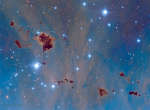
What are these strange space globs? Situated in rich star fields and glowing hydrogen gas, these opaque clouds of interstellar dust and gas are so large they might be able to form stars. Their...
 APOD: 2024 October 16 Б Colorful Aurora over New Zealand
16.10.2024
Sometimes the night sky is full of surprises. Take the sky over Lindis Pass, South Island, New Zealand one-night last week. Instead of a typically calm night sky filled with constant stars, a busy and dynamic night sky appeared.
 All of These Space Images are Fake Except One
9.11.2021
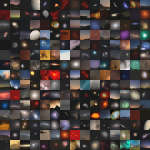
Why would you want to fake a universe? For one reason -- to better understand our real universe. Many astronomical projects seeking to learn properties of our universe now start with a robotic telescope taking sequential images of the night sky.
 APOD is 25 Years Old Today
16.06.2020
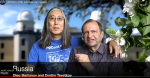
Welcome to the quadranscentennial year of the Astronomy Picture of the Day. Perhaps a source of consistency for some, APOD is still here. To help celebrate APOD's Silver Anniversary, some of APOD's TVAoTaSMD have recorded a birthday greeting and thanks to APOD's readership in today's featured video.
 APOD is One Year Old Today
16.06.1996
The first Astronomy Picture of the Day (APOD) appeared one year ago today. Pictured above are Robert Nemiroff (left) and Jerry Bonnell (right), engaged in creating the APOD web pages. APOD started over speculative conversations on the ultimate value of the World Wide Web.
 APOD: 2026 February 9 Б Miranda Revisited
9.02.2026
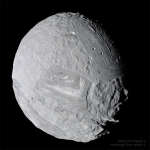
What is Miranda really like? Visually, old images from NASA's Voyager 2 have been recently combined and remastered to result in the featured image of Uranus's 500-kilometer-wide moon. In the late 1980s...
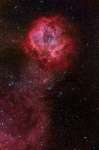 Long Stem Rosette
14.02.2008
The Rosette Nebula (aka NGC 2237) is not the only cosmic cloud of gas and dust to evoke the imagery of flowers. But it is the one most often suggested as a suitable astronomy image for Valentine's Day.
|
January February March April May June July August September |
|||||||||||||||||||||||||||||||||||||||||||||||||