
|
You entered: century
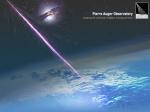 Cosmic Rays from Galactic Centers
12.11.2007
Where do cosmic rays come from? A major step toward answering this century old question may have just come in from the Auger Observatory project, the world's premier cosmic ray observatory. That high energy fundamental particles are barreling through the universe has been known for about a century.
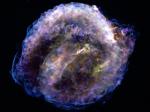 Keplers Supernova Remnant in X Rays
16.01.2007
What caused this mess? Some type of star exploded to create the unusually shaped nebula known as Kepler's supernova remnant, but which type? Light from the stellar explosion that created this energized cosmic cloud was first seen on planet Earth in October 1604, a mere four hundred years ago.
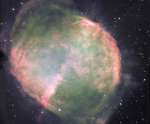 M27: Not A Comet
26.06.2008
Born on June 26th in 1730, astronomer Charles Messier scanned 18th century French skies for comets. To avoid confusion and aid his comet hunting, he diligently recorded this object as number 27 on his list of things which are definitely not comets.
 APOD: 2026 July 24 Б RCW 86: Historical Supernova Remnant
24.07.2026
In 185 AD, Chinese astronomers recorded the appearance of a new star in the Nanmen asterism. That part of the sky is identified with part of the southern constellation Centaurus on modern star charts.
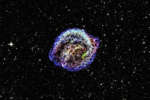 Kepler's Supernova Remnant in X Rays
15.05.2013
What caused this mess? Some type of star exploded to create the unusually shaped nebula known as Kepler's supernova remnant, but which type? Light from the stellar explosion that created this energized cosmic cloud was first seen on planet Earth in October 1604, a mere four hundred years ago.
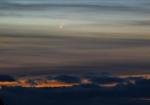 McNaught Now Brightest Comet in Decades
9.01.2007
The brightest comet in decades is unexpectedly now visible. The most optimistic predictions have Comet McNaught (C/2006 P1) shortly becoming one of the brightest comets of the past century. For the next few days...
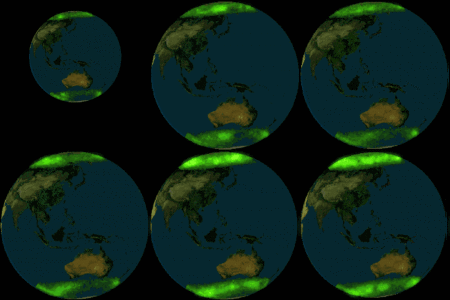 Auroras Over Both Earth Poles
14.11.2001
Auroras in the north and south can be nearly mirror images of each other. Such mirroring had been suspected for centuries but dramatically confirmed only last month by detailed images from NASA's orbiting Polar spacecraft.
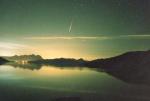 Dawn of the Leonids
22.12.1998
Many of the 1998 Leonid shower meteors were so bright they could be seen even during sunrise. The above photograph was taken near the dawn of November 16 close to Hong Kong, China. However, most meteors are fainter and are not associated with any particular meteor shower.
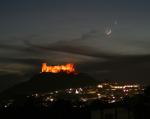 Castle and Sky
27.01.2007
While Comet McNaught ruled southern skies, last week's conjunction of the Moon and Venus could be enjoyed by denizens of both hemispheres of planet Earth. The two more commonly viewed celestial beacons produced this lovely twilight scene, recorded last Saturday in skies above Almodovar near Cordoba in southern Spain.
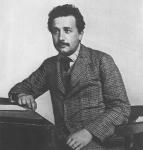 Albert Einstein Describes Space and Time
8.01.2000
Albert Einstein (1879-1955) is considered by many the greatest astrophysicist and single most significant Person of the 20th Century. He is pictured here in the Swiss Patent Office where he did much of his defining work.
|
January February March April May June July August September |
|||||||||||||||||||||||||||||||||||||||||||||||||