
|
You entered: dust disk
 Abell 3627 in the Great Attractor
17.02.1996
Are these galaxies near the center of the largest gravitationally bound concentration of mass yet known? Previously, the cluster of galaxies known as Abell 3627 was largely unstudied because dust in the disk of our own Galaxy obscured much of its light.
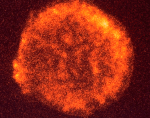 Tychos Supernova Remnant in X ray
6.03.1999
How often do stars explode? By looking at external galaxies, astronomers can guess that these events, known as a supernovae, should occur about once every 30 years in a typical spiral galaxy like our MilkyWay.
 NGC 7814: Little Sombrero
22.01.2025
Point your telescope toward the high flying constellation Pegasus and you can find this cosmic expanse of Milky Way stars and distant galaxies. NGC 7814 is centered in the sharp field of view that would almost be covered by a full moon.
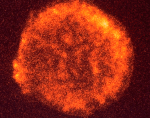 Tycho's Supernova Remnant in X-ray
23.06.1996
How often do stars explode? By looking at external galaxies, astronomers can guess that these events, known as a supernovae, should occur about once every 30 years in a typical spiral galaxy like our MilkyWay.
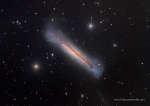 NGC 3628: The Hamburger Galaxy
2.05.2017
No, hamburgers are not this big. What is pictured is a sharp telescopic views of a magnificent edge-on spiral galaxy NGC 3628 show a puffy galactic disk divided by dark dust lanes. Of course, this deep galactic portrait puts some astronomers in mind of its popular moniker, The Hamburger Galaxy.
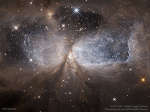 Star Forming Region S106
15.02.2016
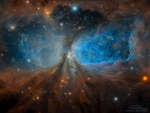
Massive star IRS 4 is beginning to spread its wings. Born only about 100,000 years ago, material streaming out from this newborn star has formed the nebula dubbed Sharpless 2-106 Nebula (S106), featured here.
 Star Forming Region S106
24.03.2020
Massive star IRS 4 is beginning to spread its wings. Born only about 100,000 years ago, material streaming out from this newborn star has formed the nebula dubbed Sharpless 2-106 Nebula (S106), featured here.
 Above the Clouds
23.04.2008
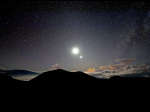
From the windswept peak of Mauna Kea, on the Big Island of Hawaii, your view of the world at night could look like this. At an altitude of about 13,500 feet, the mountain top is silhouetted in the stunning skyscape recorded near dusk in early December of 2005.
 Star Forming Region S106
19.02.2001
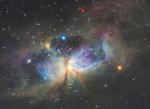
Massive star IRS4 is beginning to spread its wings. Born only about 100,000 years ago, material streaming out from this newborn star has formed the nebula dubbed Sharpless 106 Nebula (S106), pictured above.
 The Infrared Sky
27.01.1998
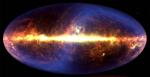
Three major sources contribute to the far-infrared sky: our Solar System, our Galaxy, and our Universe. The above image, in representative colors, is a projection of the entire infrared sky created from years of observations by the robot spacecraft COBE.
|
January February March April May June July August September |
|||||||||||||||||||||||||||||||||||||||||||||||||