
|
You entered: molecular cloud
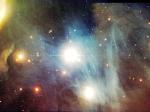 A Chamaeleon Sky
9.06.2002
A photogenic group of nebulae can be found toward Chamaeleon, a constellation visible predominantly in skies south of the Earth's equator. Celestial objects visible there include the blue reflection nebulas highlighted by thin dust surrounding the bright stars in the above image center.
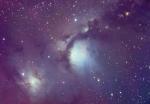 The Reflecting Dust Clouds of Orion
21.01.2003
In the vast Orion Molecular Cloud complex, several bright blue nebula are particularly apparent. Pictured above are two of the most prominent reflection nebulas -- dust clouds lit by the reflecting light of bright-embedded stars. The more famous nebula is M78, on the upper right, cataloged over 200 years ago.
 Young Star Cluster NGC 346
2.05.2025
The most massive young star cluster in the Small Magellanic Cloud is NGC 346, embedded in our small satellite galaxy's largest star forming region some 210,000 light-years distant. Of course the massive stars of NGC 346 are short lived, but very energetic.
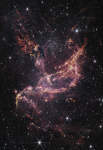 Young Star Cluster NGC 346
13.01.2023
The most massive young star cluster in the Small Magellanic Cloud is NGC 346, embedded in our small satellite galaxy's largest star forming region some 210,000 light-years distant. Of course the massive stars of NGC 346 are short lived, but very energetic.
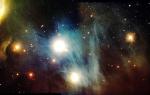 A Chamaeleon Sky
23.03.1999
A photogenic group of nebulae can be found in Chamaeleon, a constellation visible predominantly in skies south of the Earth's equator. Towards Chamaeleon, dark molecular clouds and bright planetary nebula NGC 3195 can be found. Visible near the center of the above photograph is a reflection nebula surrounding a young bright star.
 A Dark Seahorse in Cepheus
7.11.2025
Spanning light-years, this suggestive shape known as the Seahorse Nebula floats in silhouette against a rich background of stars and glowing hydrogen gas. Seen toward the royal northern constellation of Cepheus, the dusty, dark nebula is part of a Milky Way molecular cloud some 1,200 light-years distant.
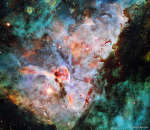 Clouds of the Carina Nebula
16.05.2016
What forms lurk in the mists of the Carina Nebula? The dark ominous figures are actually molecular clouds, knots of molecular gas and dust so thick they have become opaque. In comparison, however, these clouds are typically much less dense than Earth's atmosphere.
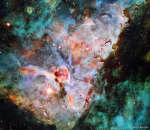 Clouds of the Carina Nebula
2.05.2021
What forms lurk in the mists of the Carina Nebula? The dark ominous figures are actually molecular clouds, knots of molecular gas and dust so thick they have become opaque. In comparison, however, these clouds are typically much less dense than Earth's atmosphere.
 The Snake Nebula from CFHT
9.04.2002
What slithers overhead? The dark winding lanes visible in part of the constellation of Ophiuchus belong to the Snake Nebula. Also known as Barnard 72, the Snake Nebula is a series of dark absorption clouds made up of molecular gas and interstellar dust.
 Lynds Dark Nebula 43
30.10.2025
Sure, Halloween is an astronomy holiday. But astronomers always enjoy scanning the heavens for spook-tacular galaxies, stars, and nebulae. This favorite is item number 43 from the Beverly Lynds 1962 Catalog of Dark Nebulae, fondly known as the Cosmic Bat nebula.
|
January February March April May June July August September October |
|||||||||||||||||||||||||||||||||||||||||||||||||