
|
You entered: naked eye
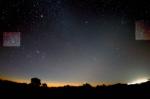 Two Comets in Southern Skies
27.05.2004
Wielding a very wide-angle lens, astronomer Gordon Garradd was able to capture two naked-eye comets in one picture looking toward the west from Loomberah, New South Wales, Australia. At the far left lies comet C/2002 T7 (LINEAR) and at the far right, comet C/2001 Q4 (NEAT).
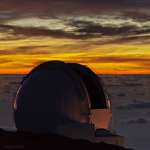 Clouds, Comet, and Crescent Moon
14.03.2013
In silhouette against the colorful evening twilight glow, clouds part in this much anticipated magic moment. The scene captures naked-eye Comet PanSTARRS peeking into northern hemisphere skies on March 12. The comet stands over the western horizon after sunset, joined by the thin, flattened crescent of a day old Moon.
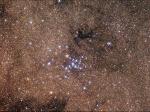 The M7 Open Star Cluster in Scorpius
6.04.2005
M7 is one of the most prominent open clusters of stars on the sky. The cluster, dominated by bright blue stars, can be seen with the naked eye in a dark sky in the tail of the constellation of Scorpius.
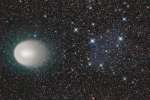 Amazing Comet Holmes
24.10.2008
One year ago, Comet 17P/Holmes amazed sky watchers across planet Earth. A stunningly rapid outburst transformed it from a faint comet quietly orbiting the Sun with a period of about 7 years to a naked-eye comet rivaling the brighter stars in the constellation Perseus.
 Venus and the Pleiades in April
10.04.2020
Shared around world in early April skies Venus, our brilliant evening star, wandered across the face of the lovely Pleiades star cluster. This timelapse image follows the path of the inner planet during the beautiful conjunction showing its daily approach to the stars of the Seven Sisters.
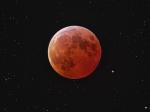 Eclipsed Moon and Stars
7.03.2007
This dramatic image features a dark red Moon during a total lunar eclipse -- celestial shadow play enjoyed by many denizens of planet Earth last Saturday. Recorded near Wildon, Austria, the picture is a composite...
 Startrails over Beijing Ancient Observatory
1.12.2023
You can take a subway ride to visit this observatory in Beijing, China but you won't find any telescopes there. Starting in the 1400s astronomers erected devices at the Beijing Ancient Observatory site to enable them to accurately measure and track the positions of naked-eye stars and planets.
 APOD: 2025 September 5 Б 47 Tucanae: Globular Star Cluster
4.09.2025
Also known as NGC 104, 47 Tucanae is a jewel of the southern sky. Not a star but a dense cluster of stars, it roams the halo of our Milky Way Galaxy along with some 200 other globular star clusters.
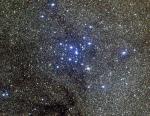 The M7 Open Star Cluster in Scorpius
5.04.2000
M7 is one of the most prominent open clusters of stars on the sky. The cluster, dominated by bright blue stars, can be seen with the naked eye in a dark sky in the tail of the constellation of Scorpius.
 Globular Star Cluster 47 Tuc
7.02.2024
Globular star cluster 47 Tucanae is a jewel of the southern sky. Also known as NGC 104, it roams the halo of our Milky Way Galaxy along with some 200 other globular star clusters. The second brightest globular cluster (after Omega Centauri) as seen from planet Earth, 47 Tuc lies about 13,000 light-years away.
|
January February March April May June July August |
||||||||||||||||||||||||||||||||||||||||||||||||||||||||