
|
You entered: open cluster
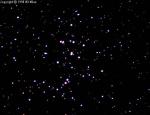 M44: A Beehive of Stars
3.08.1998
M44 is a prominent open cluster of stars. Nicknamed Praesepe and "The Beehive", it is one of the few open clusters visible to the unaided eye. M44 was thought to be a nebula until Galileo used an early telescope to resolve the cluster's bright blue stars. These stars are visible in the above image.
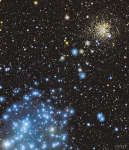 Star Clusters M35 and NGC 2158
10.05.2021
Clusters of stars can be near or far, young or old, diffuse or compact. The featured image shows two quite contrasting open star clusters in the same field. M35, on the lower left...
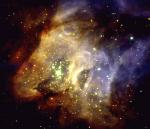 Star Forming Region RCW38
7.12.1998
Star cluster RCW38 was hiding. This open cluster of stars is located about 5000 light years away towards the constellation of Vela. Looking there will not normally reveal most of the stars in this cluster, though.
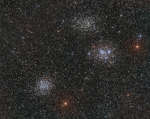 Three Clusters in Puppis
18.02.2022
Galactic or open star clusters are young. The swarms of stars are born together near the plane of the Milky Way, but their numbers steadily dwindle as cluster members are ejected by galactic tides and gravitational interactions.
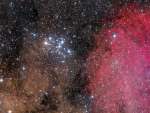 M6: The Butterfly Cluster
3.09.2014
To some, the outline of the open cluster of stars M6 resembles a butterfly. M6, also known as NGC 6405, spans about 20 light-years and lies about 2,000 light years distant. M6, pictured...
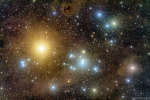 The Hyades Star Cluster
22.01.2020
It is the closest cluster of stars to the Sun. The Hyades open cluster is bright enough to have been remarked on even thousands of years ago, yet is not as bright or compact as the nearby Pleiades (M45) star cluster.
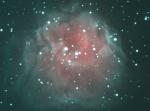 Sharpless 212 in Hydrogen and Sulfur
18.12.2001
Where do the most massive stars form? Observational evidence indicates that the outskirts of developing open clusters of stars are primary locations. Pictured above is one such open cluster: Sharpless 212. Visible in the image center are massive stars in the open cluster.
 Comet Hartley Passes a Double Star Cluster
26.10.2010
Most star clusters are singularly impressive. Open clusters NGC 869 and NGC 884, however, are doubly impressive. Also known as "h and chi Persei", this unusual double cluster, shown above, is bright enough to be seen from a dark location without even binoculars.
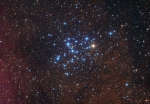 M6: The Butterfly Cluster
6.09.2011
To some, the outline of the open cluster of stars M6 resembles a butterfly. M6, also known as NGC 6405, spans about 20 light-years and lies about 2,000 light years distant.
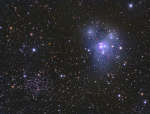 NGC 7129 and NGC 7142
30.08.2019
This wide-field telescopic image looks toward the constellation Cepheus and an intriguing visual pairing of dusty reflection nebula NGC 7129 (right) and open star cluster NGC 7142. The two appear separated by only half a degree on the sky, but they actually lie at quite different distances.
|
January February March April May June July August September October |
|||||||||||||||||||||||||||||||||||||||||||||||||