
|
You entered: stars
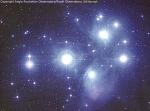 The Pleiades Star Cluster
27.02.2000
It is the most famous star cluster on the sky. The Pleiades can be seen without binoculars from even the depths of a light-polluted city. Also known as the Seven Sisters and M45, the Pleiades is one of the brightest and closest open clusters.
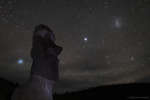 Stars Over Easter Island
12.10.2009
Why were the statues on Easter Island built? No one is sure. What is sure is that over 800 large stone statues exist there. The Easter Island statues, stand, on the average, over twice as tall as a person and have over 200 times as much mass.
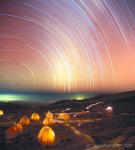 The Star Trails of Kilimanjaro
7.03.2003
The night had no moon, but the stars were out. And camped at 16,000 feet on Mt. Kilimanjaro, photographer Dan Heller recorded this marvelous 3 1/2 hour long exposure. Here the landscape is lit mostly by the stars.
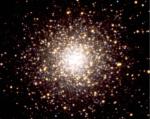 M3: Half A Million Stars
17.09.1999
This immense ball of half a million stars older than the sun lies 30,000 light-years above the plane of our Galaxy. Cataloged as M3 (and NGC 5272), it is one of about 250 globular star clusters which roam our galactic halo.
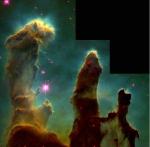 Stars from Eagle's EGGs
12.04.1998
Newborn stars are forming in the Eagle Nebula. This image, taken with the Hubble Space Telescope in 1995, shows evaporating gaseous globules (EGGs) emerging from pillars of molecular hydrogen gas and dust. The giant pillars are light years in length and are so dense that interior gas contracts gravitationally to form stars.
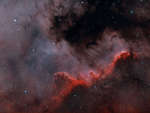 The Cygnus Wall of Star Formation
22.01.2013
The North America nebula on the sky can do what the North America continent on Earth cannot -- form stars. Specifically, in analogy to the Earth-confined continent, the bright part that appears as Central America and Mexico is actually a hot bed of gas, dust, and newly formed stars known as the Cygnus Wall.
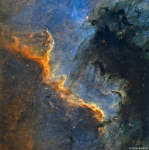 The Cygnus Wall of Star Formation
15.08.2022
The North America nebula on the sky can do what the North America continent on Earth cannot -- form stars. Specifically, in analogy to the Earth-confined continent, the bright part that appears as Central America and Mexico is actually a hot bed of gas, dust, and newly formed stars known as the Cygnus Wall.
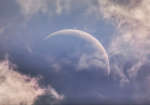 APOD: 2026 June 20 Б Daytime Moon Meets Evening Star
20.06.2026
Venus is now appearing on the celestial stage as Earth's brilliant evening star, performing with the Moon, other wandering planets, and bright stars in western skies. For evening sky gazers on June 17, the celestial beacon rose after sunset close by a young, slender, crescent Moon.
 Proxima Centauri: The Closest Star
15.07.2002
What is the closest star to our Sun? It is Proxima Centauri, the nearest member of the Alpha Centauri triple star system. Light takes only 4.22 years to reach us from Proxima Centauri. This...
 Star Trails in Southern Skies
15.07.2000
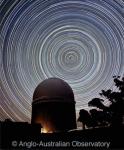
As the Earth spins on its axis, the stars seem to rotate around us. This motion produces the beautiful concentric arcs traced out by the stars in this time exposure of the southern hemisphere night sky. In the foreground is the dome of the Anglo-Australian Telescope in central New South Wales, Australia.
|
January February March April May June July August September October |
|||||||||||||||||||||||||||||||||||||||||||||||||