
|
You entered: tail
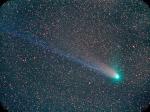 The Tails of Comet NEAT Q4
12.05.2004
Comet NEAT (Q4) is showing its tails. As the large snowball officially dubbed Comet C/2001 Q4 (NEAT) falls toward the inner Solar System, it has already passed the Earth and will reach its closest approach to the Sun this coming Saturday.
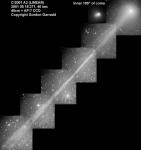 LINEAR s Tail and Two Nuclei
31.05.2001
Arcing toward southern skies in late March, this faint comet LINEAR - the one officially designated C/2001 A2 (LINEAR) - brightened unexpectedly. The outburst, apparently due to the fragmentation of its nucleus, delighted observers as the comet eventually increased to naked-eye brightness.
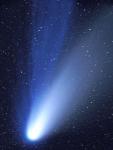 The Dust and Ion Tails of Comet Hale Bopp
27.12.2000
In 1977, Comet Hale-Bopp's intrinsic brightness exceeded any comet since 1811. Since it peaked on the other side of the Earth's orbit, however, the comet appeared only brighter than any comet in two decades. Visible above are the two tails shed by Comet Hale-Bopp.
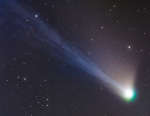 Tails of Comet Lemmon
6.05.2013
What caused the interestingly intricate tails that Comet Lemmon displayed earlier this year? First of all, just about every comet that nears the Sun displays two tails: a dust tail and an ion tail.
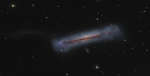 The Tail of the Hamburger Galaxy
8.05.2014
Sharp telescopic views of NGC 3628 show a puffy galactic disk divided by dark dust lanes. Of course, this deep portrait of the magnificent, edge-on spiral galaxy puts some astronomers in mind of its popular moniker, the Hamburger Galaxy.
 APOD: 2024 October 15 Б Animation: Comet Tsuchinshan ATLAS Tails Prediction
15.10.2024
How bright and strange will the tails of Comet Tsuchinshan-ATLAS become? The comet has brightened dramatically over the few weeks as it passed its closest to the Sun and, just three days ago, passed its closest to the Earth.
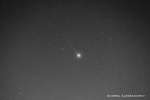 Mercurys Sodium Tail
8.07.2020
What is that fuzzy streak extending from Mercury? Long exposures of our Solar System's innermost planet may reveal something unexpected: a tail. Mercury's thin atmosphere contains small amounts of sodium that glow when excited by light from the Sun. Sunlight also liberates these molecules from Mercury's surface and pushes them away.
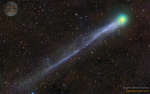 Comet Lovejoy s Tail
16.01.2015
Sweeping north in planet Earth's sky, Comet Lovejoy's greenish coma and blue tinted ion tail stretched across this field of stars in the constellation Taurus on January 13. The inset at the upper left shows the 1/2 degree angular size of the full moon for scale.
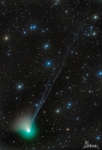 APOD: 2023 January 9 Б Tails of Comet ZTF
9.01.2023
Comet ZTF may become visible to the unaided eye. Discovered early last year, this massive snowball has been brightening as it approaches the Sun and the Earth. C/2022 E3 (ZTF) will be closest...
 APOD: 2024 April 8 Б The Changing Ion Tail of Comet Pons Brooks
8.04.2024
How does a comet tail change? It depends on the comet. The ion tail of Comet 12P/PonsБBrooks has been changing markedly, as detailed in the featured image sequenced over nine days from March 6 to 14 (top to bottom).
|
January February March April May June July August September October |
|||||||||||||||||||||||||||||||||||||||||||||||||