
|
You entered: young stars
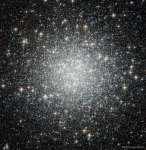 Blue Straggler Stars in Globular Cluster M53
7.02.2021
If our Sun were part of this star cluster, the night sky would glow like a jewel box of bright stars. This cluster, known as M53 and cataloged as NGC 5024, is one of about 250 globular clusters that survive in our Galaxy.
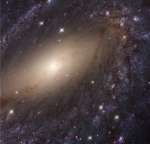 NGC 6744: Extragalactic Close Up
25.11.2022
Beautiful spiral galaxy NGC 6744 is nearly 175,000 light-years across. That's larger than the Milky Way. It lies some 30 million light-years distant in the southern constellation Pavo, with its galactic disk tilted towards our line of sight.
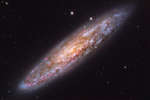 NGC 253: Dusty Island Universe
6.11.2025
Shiny NGC 253 is one of the brightest spiral galaxies visible, and also one of the dustiest. Some call it the Silver Coin Galaxy for its appearance in small telescopes, or just the Sculptor Galaxy for its location within the boundaries of the southern constellation Sculptor.
 APOD: 2025 October 21 Б IC 1805: The Heart Nebula
21.10.2025
What electrifies the Heart Nebula? First, the large emission nebula on the left, catalogued as IC 1805, looks somewhat like a human heart. The nebula glows brightly in red light emitted by its most prominent element, hydrogen, but this long-exposure image was also blended with light emitted by sulfur (yellow) and oxygen (blue).
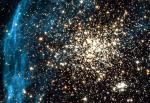 NGC 1850: Not Found in the Milky Way
12.07.2001
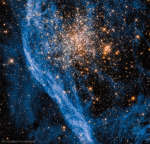
A mere 168,000 light-years distant, this large, lovely cluster of stars, NGC 1850, is located near the outskirts of the central bar structure in our neighboring galaxy, the Large Magellanic Cloud. A first...
 APOD: 2023 February 20 Б NGC 1850: Not Found in the Milky Way
20.02.2023
There is nothing like this ball of stars in our Milky Way Galaxy. This is surprising because, at first glance, this featured image by the Hubble Space Telescope suggests that star cluster NGC 1850...
 X-Ray Stars Of Orion
4.02.2000
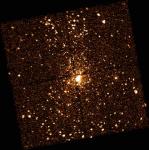
The stars of Orion shine brightly in northern winter skies where the constellation harbors the closest large stellar nursery, the Great Nebula of Orion, a mere 1500 light-years away. In fact, the apparently bright...
 LMC Star Clouds
11.10.1995
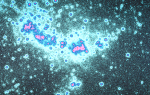
Pictured above are clouds of young stars forming an arc in the nearby Large Magellanic Cloud, the nearest galaxy to the our Milky Way Galaxy. These stars are situated in a star forming region known as N 51.
 Hydrogen and Dust in the Rosette Nebula
23.12.2005
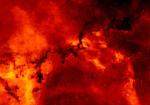
At the edge of a large molecular cloud in Monoceros, some 3,000 light years away, dark filaments of dust are silhouetted by luminous hydrogen gas. The close up view of the Rosette Nebula...
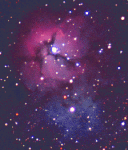 M20: The Trifid Nebula
23.07.1995
The vivid blue and violet colors present in the Trifid Nebula result from the abundance of young stars there. The light from young massive stars is quite blue and has the ability to remove electrons from surrounding gas. When these electrons re-combine with the gas, radiation rich in blue and violet light is emitted.
|
January February March April May June July August September October |
|||||||||||||||||||||||||||||||||||||||||||||||||