
|
You entered: Earth orbit
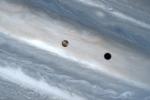 Io Shadow
23.04.1999
Orbiting Jupiter once every 43 hours, the volcanic moon Io cruises 500,000 kilometers above swirling, banded cloud-tops. Orbiting Earth once every 1.5 hours, the Hubble Space Telescope watched as Io accompanied by its shadow crossed the face of the reigning gas giant planet in 1997.
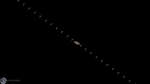 International Space Station Transits Saturn
21.01.2016
From low Earth orbit to the outer Solar System, this remarkable video frame composite follows the International Space Station's transit of Saturn. On January 15, the well-timed capture from a site near Dulmen, Germany required telescope and camera to be positioned along the predicted transit centerline, a path only 40 meters wide.
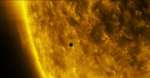 A Mercury Transit Music Video from SDO
10.05.2016
What's that small black dot moving across the Sun? Mercury. Possibly the clearest view of Mercury crossing in front of the Sun earlier this week was from Earth orbit. The Solar Dynamics Observatory obtained an uninterrupted vista recording it not only in optical light but also in bands of ultraviolet light.
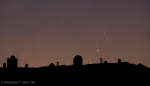 Full Venus and Crescent Moon Rise
13.04.2016
Inner planet Venus and a thin crescent Moon are never found far from the Sun in planet Earth's skies. Taken near dawn on April 6, this timelapse composite shows them both rising just before the Sun. The mountaintop Teide Observatory domes on the fortunate island of Tenerife appear in silhouette against the twilight.
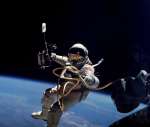 Into the Void
5.06.2015
Fifty years ago, on June 3, 1965, Edward White stepped out of the orbiting Gemini 4 spacecraft to become the first US astronaut to walk in space. White is captured in this photo taken...
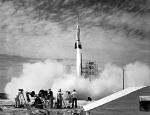 The First Rocket Launch from Cape Canaveral
22.10.2001
A new chapter in space flight began on 1950 July with the launch of the first rocket from Cape Canaveral, Florida: the Bumper 2. Shown above, the Bumper 2 was an ambitious two-stage rocket program that topped a V-2 missile base with a WAC Corporal rocket.
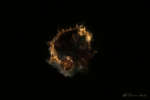 A Falcon 9 Nebula
3.09.2021
Not the Hubble Space Telescope's latest view of a distant galactic nebula, this illuminated cloud of gas and dust dazzled early morning spacecoast skygazers on August 29. The snapshot was taken at 3:17am from Space View Park in Titusville, Florida.
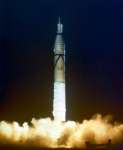 The First Explorer
31.01.2008
Fifty years ago (on January 31, 1958) the First Explorer, was launched into Earth orbit by the Army Ballistic Missile Agency. Inaugurating the era of space exploration for the United States, Explorer I was a thirty pound satellite that carried instruments to measure temperatures, and micrometeorite impacts, along with an experiment designed by James A.
 APOD: 2023 October 29 Б A Partial Lunar Eclipse
28.10.2023
What's happened to the Moon? Within the last day, part of the Moon moved through the Earth's shadow. This happens about once or twice a year, but not every month since the Moon's orbit around the Earth is slightly tilted.
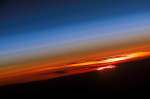 Sunset: Planet Earth
19.03.2008
Today, the Sun crosses the celestial equator heading north at 0548 UT. Known as the equinox, the geocentric astronomical event marks the first day of spring in the northern hemisphere and autumn in the south.
|
January February March April May June July August September October |
|||||||||||||||||||||||||||||||||||||||||||||||||