
|
You entered: Ring Nebula
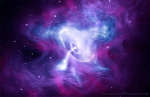 The Spinning Pulsar of the Crab Nebula
21.08.2022
At the core of the Crab Nebula lies a city-sized, magnetized neutron star spinning 30 times a second. Known as the Crab Pulsar, it is the bright spot in the center of the gaseous swirl at the nebula's core.
 APOD: 2025 August 24 Б The Spinning Pulsar of the Crab Nebula
24.08.2025
At the core of the Crab Nebula lies a city-sized, magnetized neutron star spinning 30 times a second. Known as the Crab Pulsar, it is the bright spot in the center of the gaseous swirl at the nebula's core.
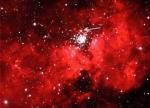 Sher 25: A Pending Supernova
27.10.2001
No supernova has ever been predicted. These dramatic stellar explosions that destroy stars and disperse elements that compose people and planets are not so well understood that astronomers can accurately predict when a star will explode - yet. Perhaps Sher 25 will be the first.
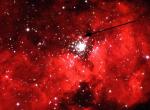 Sher 25: A Pending Supernova?
12.08.1997
No supernova has ever been predicted - yet. These dramatic stellar explosions that destroy stars, that create and disperse the elements that compose people and planets, that light up the night sky, are not so well understood that astronomers can accurately predict when a star will explode - yet. Perhaps Sher 25 will be the first.
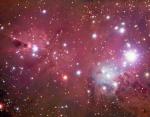 The Mysterious Cone Nebula
7.01.2002
Sometimes the simplest shapes are the hardest to explain. For example, the origin of the mysterious cone-shaped region seen on the far left remains a mystery. The interstellar formation, dubbed the Cone Nebula, is located about 2700 light years away.
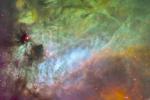 Elements of the Swan Nebula
11.08.2003
In the depths of the dark clouds of dust and molecular gas known as M17, stars continue to form. Also known as the Omega Nebula and Horseshoe Nebula, the darkness of M17's molecular clouds results from background starlight being absorbed by thick filaments of carbon-based smoke-sized dust.
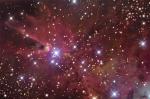 The Mysterious Cone Nebula
25.12.2005
Sometimes the simplest shapes are the hardest to explain. For example, the origin of the mysterious cone-shaped region seen on the far left remains a mystery. The interstellar formation, dubbed the Cone Nebula, is located about 2700 light years away.
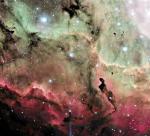 Close Up of the Lagoon Nebula
16.08.2004
Stars are battling gas and dust in the Lagoon Nebula but the photographers are winning. Also known as M8, this photogenic nebula is visible even without binoculars towards the constellation of Sagittarius. The energetic processes of star formation create not only the colors but the chaos.
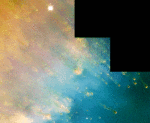 At the Edge of the Helix
22.04.1996
While exploring the inner edge of the Helix Nebula with the Hubble Space Telescope's Wide Field Planetary Camera 2, astronomers were able to produce this striking image - rich in details of an exotic environment.
 At the Edge of the Helix
20.07.1997
While exploring the inner edge of the Helix Nebula with the Hubble Space Telescope's Wide Field Planetary Camera 2, astronomers were able to produce this striking image - rich in details of an exotic environment.
|
January February March April May June July August September October |
|||||||||||||||||||||||||||||||||||||||||||||||||