
|
You entered: ice
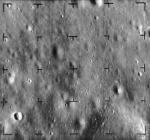 The Sea of Tranquillity: 5 Seconds To Impact
30.07.1999
On February 20th, 1965, the Ranger 8 spacecraft crashed into the Moon. Rapidly transmitting a series of pictures to ground controllers, its camera recorded this one at an altitude of about 11 kilometers, 5 seconds before impacting the lunar surface. Two kilometers across, with 4 meter
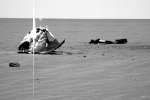 Metal on the Plains of Mars
31.07.2011
What has the Opportunity rover found on Mars? While traversing a vast empty plain in 2005 in Meridiani Planum, one of Earth's rolling robots on Mars found a surprise when visiting the location of its own metallic heat shield discarded last year during descent.
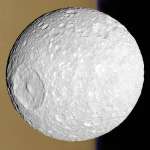 Mimas: Small Moon with a Big Crater
21.10.2014
Whatever hit Mimas nearly destroyed it. What remains is one of the largest impact craters on one of Saturn's smallest moons. The crater, named Herschel after the 1789 discoverer of Mimas, Sir William Herschel, spans about 130 kilometers and is pictured above.
 Global Ocean Suspected on Saturns Enceladus
20.09.2015
Do some surface features on Enceladus roll like a conveyor belt? A leading interpretation of images taken of Saturn's most explosive moon indicate that they do. This form of asymmetric tectonic activity, very...
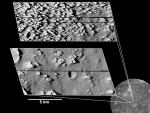 Jagged Hills on Jupiters Callisto
28.08.2001
Why does Jupiter's moon Callisto have unusual jagged hills? This mystery came to light after the robot spacecraft Galileo, in orbit around Jupiter since 1995, swooped past the dark moon in May. The resulting pictures were the highest resolution yet obtained for a Jovian moon: objects as small as 3 meters across are discernable.
 Global Warming Predictions
21.04.2009
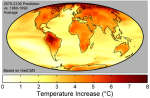
How much will the Earth's surface warm up over the lives of our children? No one is sure. Compared to the past 100 million years, the Earth is currently enduring a relative cold spell, possibly about four degrees Celsius below average.
 APOD: 2026 April 12 Б Comet R3 PanSTARRS Brightens
12.04.2026
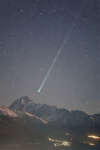
Comet R3 is brightening rapidly -- will it survive? C/2025 R3 (PanSTARRS) has been slowly brightening and extending an ion tail since its discovery last year. This shedding mountain of dirty ice puts...
 APOD: 2026 April 14 Б The Long Wispy Tail of Comet R3 (PanSTARRS)
14.04.2026
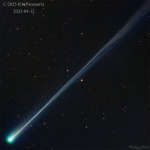
Why does Comet R3 (PanSTARRS) have a wispy tail? The newest bright member of the inner Solar System, Comet C/2025 R3 (PanSTARRS) is already extending an impressive stream of glowing gas. This tail starts from an unseen central nucleus of dirty ice that is likely a few kilometers across.
 Could Hydrogen Peroxide Life Survive on Mars
28.08.2007
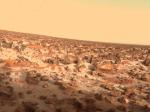
Is there life on Mars? Although no unambiguous evidence for indigenous life on Mars has ever been found, a more speculative question -- could some life forms survive on Mars -- has taken on a new twist.
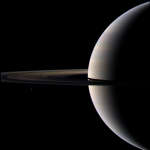 Saturn After Equinox
10.11.2009
The other side of Saturn's ring plane is now directly illuminated by the Sun. For the previous 15 years, the southern side of Saturn and its rings were directly illuminated, but since Saturn's equinox in August, the orientation has reversed.
|
January February March April May June July August September |
|||||||||||||||||||||||||||||||||||||||||||||||||