
|
You entered: red giant
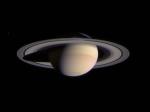 Cassini Closes in on Saturn
1.03.2004
Are they gone? They were not originally predicted to even be there. The mystery revolves around strange shadow-like spokes that appeared on Saturn's large B-ring, the large middle ring in the complex system of particles that orbits Saturn.
 APOD: 2024 July 22 Б Chamaeleon Dark Nebulas
22.07.2024
Sometimes the dark dust of interstellar space has an angular elegance. Such is the case toward the far-south constellation of Chamaeleon. Normally too faint to see, dark dust is best known for blocking visible light from stars and galaxies behind it.
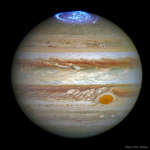 Aurorae on Jupiter
11.07.2016
Jupiter has aurorae. Like Earth, the magnetic field of the gas giant funnels charged particles released from the Sun onto the poles. As these particles strike the atmosphere, electrons are temporarily knocked away from existing gas molecules. Electric force attracts these electrons back. As the electrons recombine to remake neutral molecules, auroral light is emitted.
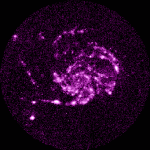 An Ultraviolet Image of M101
27.06.1995
This giant spiral galaxy, Messier 101 (M101), was photographed by the Ultraviolet Imaging Telescope onboard the Space Shuttle Endeavour during the Astro-2 mission (March 2 - 18, 1995). The image has been computer processed so that the colors represent the intensity of ultraviolet light.
 APOD: 2025 November 19 Б Chamaeleon Dark Nebulas
19.11.2025
Sometimes the dark dust of interstellar space has an angular elegance. Such is the case toward the far-south constellation of Chamaeleon. Normally too faint to see, dark dust is best known for blocking visible light from stars and galaxies behind it.
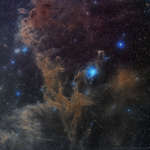 Chamaeleon Dark Nebulas
17.01.2022
Sometimes the dark dust of interstellar space has an angular elegance. Such is the case toward the far-south constellation of Chamaeleon. Normally too faint to see, dark dust is best known for blocking visible light from stars and galaxies behind it.
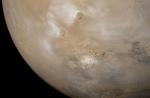 The Fogs of Mars
2.06.2003
Fogs of clouds and dust covered parts of southern Mars during last Martian winter. Giant volcanoes, such as Ascraeus Mons, the central circular feature near the top of the image, were surrounded by large water clouds. Slightly southwest, Pavonis Mons and Arisa Mons also peeked above their water clouds.
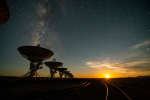 The Very Large Array at Moonset
9.10.2020
An inspirational sight, these giant dish antennas of the Karl G. Jansky Very Large Array (VLA) rise above the New Mexico desert at moonset. Mounted on piers but transportable on railroad tracks to change...
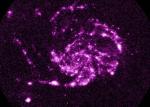 M101: An Ultraviolet View
8.06.1997
This giant spiral galaxy, Messier 101 (M101), was photographed by the Ultraviolet Imaging Telescope (UIT). UIT flew into orbit as part of the Astro 2 mission on-board the Space Shuttle Endeavour in March 1995. The image has been processed so that the colors (purple to white) represent an increasing intensity of ultraviolet light.
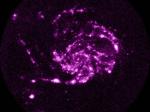 M101: An Ultraviolet View
10.06.2000
This picture of giant spiral galaxy Messier 101 (M101) was taken by the Ultraviolet Imaging Telescope (UIT). UIT flew into orbit as part of the Astro 2 mission on-board the Space Shuttle Endeavour in March 1995.
|
January February March April May June July August September October |
|||||||||||||||||||||||||||||||||||||||||||||||||