
|
You entered: spiral galaxy
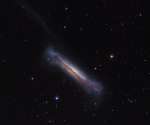 Sideways Galaxy NGC 3628
15.03.2011
Dark dust lanes cut across the middle of this gorgeous island universe, a strong hint that NGC 3628 is a spiral galaxy seen sideways. About 35 million light-years away in the northern springtime constellation...
 NGC 247 and Friends
4.09.2024
About 70,000 light-years across, NGC 247 is a spiral galaxy smaller than our Milky Way. Measured to be only 11 million light-years distant it is nearby though. Tilted nearly edge-on as seen from our perspective, it dominates this telescopic field of view toward the southern constellation Cetus.
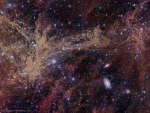 The M81 Galaxy Group through the Integrated Flux Nebula
26.06.2017
Distant galaxies and nearby nebulas highlight this deep image of the M81 Group of galaxies. First and foremost in this 80-exposure mosaic is the grand design spiral galaxy M81, the largest galaxy in the image, visible on the lower right.
 Messier 101
26.11.2021
Big, beautiful spiral galaxy M101 is one of the last entries in Charles Messier's famous catalog, but definitely not one of the least. About 170,000 light-years across, this galaxy is enormous, almost twice the size of our own Milky Way.
 Messier 101
1.06.2023
Big, beautiful spiral galaxy M101 is one of the last entries in Charles Messier's famous catalog, but definitely not one of the least. About 170,000 light-years across, this galaxy is enormous, almost twice the size of our own Milky Way.
 Messier 101
15.05.2025
Big, beautiful spiral galaxy M101 is one of the last entries in Charles Messier's famous catalog, but definitely not one of the least. About 170,000 light-years across, this galaxy is enormous, almost twice the size of our own Milky Way.
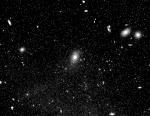 The Virgo Cluster of Galaxies
19.02.2000
Pictured are several galaxies of the Virgo Cluster, the closest cluster of galaxies to our Milky Way Galaxy. The Virgo Cluster spans more than 5 degrees on the sky - about 10 times the angle made by a full Moon. It contains over 100 galaxies of many types - including spirals, ellipticals, and irregular galaxies.
 APOD: 2025 July 4 Б NGC 6946 and NGC 6939
3.07.2025
Face-on spiral galaxy NGC 6946 and open star cluster NGC 6939 share this cosmic snapshot, composed with over 68 hours of image data captured with a small telescope on planet Earth. The field of view spans spans about 1 degree or 2 full moons on the sky toward the northern constellation Cepheus.
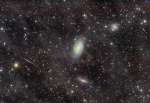 The M81 Galaxy Group Through the Integrated Flux Nebula
13.03.2012
Large galaxies and faint nebulae highlight this deep image of the M81 Group of galaxies. First and foremost in the wide-angle 12-hour exposure is the grand design spiral galaxy M81, the largest galaxy visible in the image.
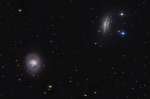 Cetus Duo M77 and NGC 1055
25.12.2014
At the top right, large spiral galaxy NGC 1055 joins spiral Messier 77 in this sharp cosmic view toward the aquatic constellation Cetus. The narrowed, dusty appearance of edge-on spiral NGC 1055 contrasts nicely with the face-on view of M77's bright nucleus and spiral arms.
|
January February March April May June July August September October |
|||||||||||||||||||||||||||||||||||||||||||||||||