
|
You entered: stars
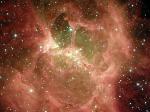 Spooky Star Forming Region DR 6
1.11.2004
How could stars form such a spooky and familiar shape as a human skull? First, the complex process of star formation creates nebulas of many shapes and sizes -- it is human perception that identifies the skull shape.
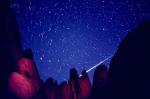 Polaris: The North Star
6.10.1999
Polaris is quite an unusual star. First, Polaris is the nearest bright star to the north spin axis of the Earth. Therefore, as the Earth turns, stars appear to rotate around Polaris, making it the North Star.
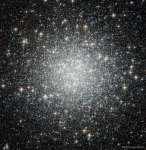 Blue Straggler Stars in Globular Cluster M53
7.02.2021
If our Sun were part of this star cluster, the night sky would glow like a jewel box of bright stars. This cluster, known as M53 and cataloged as NGC 5024, is one of about 250 globular clusters that survive in our Galaxy.
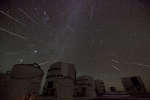 When Gemini Sends Stars to Paranal
13.12.2015
From a radiant point in the constellation of the Twins, the annual Geminid meteor shower rain down on planet Earth. Tonight, the Geminds reach their peak and could be quite spectacular. The featured blended image, however, captured the shower's impressive peak in the year 2012.
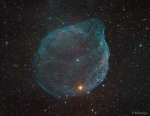 Sharpless 308: Star Bubble
23.06.2015
Blown by fast winds from a hot, massive star, this cosmic bubble is huge. Cataloged as Sharpless 2-308 it lies some 5,200 light-years away toward the constellation of the Big Dog (Canis Major) and covers slightly more of the sky than a Full Moon.
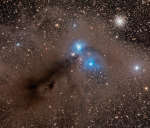 Stars and Dust Across Corona Australis
27.09.2012
Cosmic dust clouds sprawl across a rich field of stars in this sweeping telescopic vista near the northern boundary of Corona Australis, the Southern Crown. Probably less than 500 light-years away and effectively blocking...
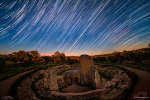 Star Trails and the Equinox Sunrise
21.03.2019
Stars trail and the Sun rises in this night and day composite panorama made on March 19. The view looks toward the eastern horizon from La Nava de Santiago, Spain. To create...
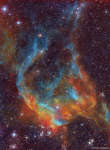 Stars, Dust, and Gas near NGC 3572
28.05.2019
Star formation can be colorful. This chromatic cosmic portrait features glowing gas and dark dust near some recently formed stars of NGC 3572, a little-studied star cluster near the Carina Nebula. Stars from...
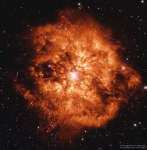 Wolf Rayet Star 124: Stellar Wind Machine
8.03.2020
Some stars explode in slow motion. Rare, massive Wolf-Rayet stars are so tumultuous and hot that they are slowly disintegrating right before our telescopes. Glowing gas globs each typically over 30 times more massive than the Earth are being expelled by violent stellar winds.
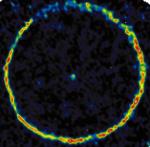 TT Cygni: Carbon Star
4.03.2001
TT Cygni is a cool red giant star with a wind. This false-color picture of TT Cyg was made using a coordinated array of millimeter wavelength radio telescopes and shows radio emission from carbon monoxide (CO) molecules in the surrounding gas.
|
January February March April May June July August September October |
|||||||||||||||||||||||||||||||||||||||||||||||||