
|
You entered: image
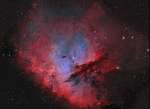 Portrait of NGC 281
25.08.2011
Look through the cosmic cloud cataloged as NGC 281 and it's almost easy to miss stars of open cluster IC 1590. But, formed within the nebula, that cluster's young, massive stars ultimately power the pervasive nebular glow.
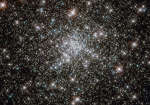 At the Core of NGC 6752
10.02.2012
This sharp Hubble Space Telescope view looks deep into NGC 6752. Some 13,000 light-years away toward the southern constellation Pavo, the globular star cluster roams the halo of our Milky Way galaxy. Over...
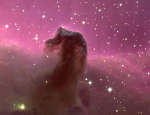 The Horsehead Nebula
21.10.2012
One of the most identifiable nebulae in the sky, the Horsehead Nebula in Orion, is part of a large, dark, molecular cloud. Also known as Barnard 33, the unusual shape was first discovered on a photographic plate in the late 1800s.
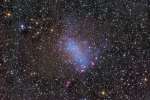 NGC 6822: Barnard s Galaxy
8.02.2013
Grand spiral galaxies often seem to get all the glory, flaunting their young, bright, blue star clusters in beautiful, symmetric spiral arms. But small galaxies form stars too, like nearby NGC 6822, also known as Barnard's Galaxy.
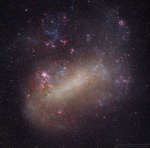 The Large Cloud of Magellan
28.05.2013
The 16th century Portuguese navigator Ferdinand Magellan and his crew had plenty of time to study the southern sky during the first circumnavigation of planet Earth. As a result, two fuzzy cloud-like objects easily...
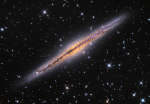 NGC 891 Edge On
11.10.2013
This sharp cosmic portrait features NGC 891. The spiral galaxy spans about 100 thousand light-years and is seen almost exactly edge-on from our perspective. In fact, about 30 million light-years distant in the constellation Andromeda, NGC 891 looks a lot like our Milky Way.
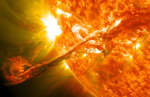 A Solar Filament Erupts
20.07.2014
What's happened to our Sun? Nothing very unusual -- it just threw a filament. Toward the middle of 2012, a long standing solar filament suddenly erupted into space producing an energetic Coronal Mass Ejection (CME).
 The Protoplanetary Disk of HL Tauri from ALMA
9.11.2014
Why does this giant disk have gaps? The exciting and probable answer is: planets. A mystery is how planets massive enough to create these gaps formed so quickly, since the HL Tauri star system is only about one million years old.
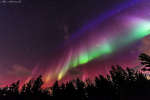 A Flag Shaped Aurora over Sweden
30.03.2015
It appeared, momentarily, like a 50-km tall banded flag. In mid-March, an energetic Coronal Mass Ejection directed toward a clear magnetic channel to Earth led to one of the more intense geomagnetic storms of recent years. A visual result was wide spread auroras being seen over many countries near Earth's magnetic poles.
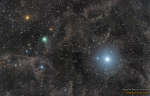 Polaris and Comet Lovejoy
2.06.2015
One of these two bright sky objects is moving. On the right is the famous star Polaris. Although only the 45th brightest star in the sky, Polaris is famous for appearing stationary. Once you find it, it will always appear in the same direction -- all night and all day -- for the rest of your life.
|
January February March April May June July August September |
|||||||||||||||||||||||||||||||||||||||||||||||||