
|
You entered: star
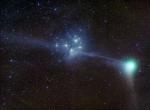 Machholz Meets the Pleiades
11.01.2005
Sweeping northward in planet Earth's sky, comet Machholz extended its long ion tail with the Pleiades star cluster in the background on January 7th. This stunning view, recorded with a telephoto lens in skies over Oberjoch, Bavaria, Germany, emphasizes faint, complex tail structures and the scene's lovely blue and green colors.
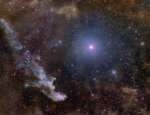 Rigel and the Witch Head Nebula
1.11.2012
Double, double toil and trouble; Fire burn, and cauldron bubble -- maybe Macbeth should have consulted the Witch Head Nebula. The suggestively shaped reflection nebula is associated with the bright star Rigel in the constellation Orion.
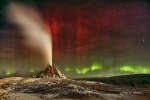 Aurora Over White Dome Geyser
20.02.2022
Sometimes both heaven and Earth erupt. Colorful auroras erupted unexpectedly a few years ago, with green aurora appearing near the horizon and brilliant bands of red aurora blooming high overhead. A bright Moon lit the foreground of this picturesque scene, while familiar stars could be seen far in the distance.
 APOD: 2024 June 17 Б Ou4: The Giant Squid Nebula
17.06.2024
Squids on Earth aren't this big. This mysterious squid-like cosmic cloud spans nearly three full moons on planet Earth's sky. Discovered in 2011 by French astro-imager Nicolas Outters, the Squid Nebula's bipolar shape is distinguished here by the telltale blue emission from doubly ionized oxygen atoms.
 APOD: 2024 September 4 Б NGC 6995: The Bat Nebula
4.09.2024
Can you see the bat? It haunts this cosmic close-up of the eastern Veil Nebula. The Veil Nebula itself is a large supernova remnant, the expanding debris cloud from the death explosion of a massive star.
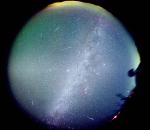 A Sky Filled with Leonids
5.12.2001
In the early morning hours of November 19, amateur Chen Huang-Ming caught a sky filled with astronomical wonders. With his fisheye camera set up on Ho-Huan Mountain in Taiwan for a half-hour exposure, he started the above image a local time of 2:33 am.
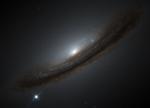 Supernova 1994D and the Unexpected Universe
12.03.2000
Far away, long ago, a star exploded. Supernova 1994D, visible as the bright spot on the lower left, occurred in the outskirts of disk galaxy NGC 4526. Supernova 1994D was not of interest for how different it was, but rather for how similar it was to other supernovae. In fact, the
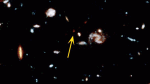 A Distant Galaxy in the Deep Field
28.06.1996
Researchers believe that the faint reddish smudge indicated by the arrow in the image above is a candidate for the most distant known galaxy which may have existed only a few hundred million years after the Big Bang.
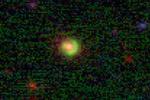 Ring Around the Galaxy
23.12.1998
It is difficult to hide one galaxy far behind another. The closer galaxy's gravity will act like a huge lens, pulling images of the background galaxy around both sides. This is just...
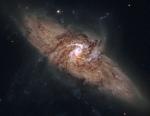 NGC 3314: When Galaxies Overlap
11.05.2000
Can this be a spiral galaxy? In fact, NGC 3314 consists of two large spiral galaxies which just happen to almost exactly line-up. The foreground spiral is viewed nearly face-on, its pinwheel shape defined by young bright star clusters.
|
January February March April May June July August September October |
|||||||||||||||||||||||||||||||||||||||||||||||||