
|
You entered: apod
 APOD: 2024 November 4 Б M42: The Great Nebula in Orion
4.11.2024
The Great Nebula in Orion, an immense, nearby starbirth region, is probably the most famous of all astronomical nebulas. Here, glowing gas surrounds hot young stars at the edge of an immense interstellar molecular cloud only 1500 light-years away.
 APOD: 2025 January 6 Б Colliding Spiral Galaxies from Webb and Hubble
6.01.2025
Billions of years from now, only one of these two galaxies will remain. Until then, spiral galaxies NGC 2207 and IC 2163 will slowly pull each other apart, creating tides of matter, sheets of shocked gas, lanes of dark dust, bursts of star formation, and streams of cast-away stars.
 APOD: 2025 June 1 Б UGC 1810: Wildly Interacting Galaxy from Hubble
1.06.2025
What's happening to this spiral galaxy? Although details remain uncertain, it surely has to do with an ongoing battle with its smaller galactic neighbor. The featured galaxy is labelled UGC 1810 by itself, but together with its collisional partner is known as Arp 273.
 APOD: 2025 July 20 Б Lunar Nearside
20.07.2025
About 1,300 images from the Lunar Reconnaissance Orbiter spacecraft's wide angle camera were used to compose this spectacular view of a familiar face - the lunar nearside. But why is there a lunar nearside? The Moon rotates on its axis and orbits the Earth at the same rate, about once every 28 days.
 APOD: 2025 September 7 Б All the Water on Planet Earth
7.09.2025
How much of planet Earth is made of water? Very little, actually. Although oceans of water cover about 70 percent of Earth's surface, these oceans are shallow compared to the Earth's radius.
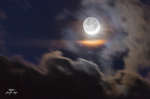 APOD: 2026 April 24 Б Young Moon and Sister Stars
24.04.2026
Sunlit arms of a crescent moon seem to embrace the faint lunar night side in this dramatic celestial scene from planet Earth. The single telephoto exposure tracking the sky was captured on the night of April 19, when a two day old Moon was near perigee in its elliptical orbit.
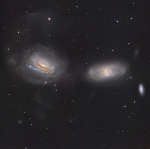 APOD: 2026 May 18 Б Unraveling NGC 3169
18.05.2026
Spiral galaxy NGC 3169 looks to be unraveling like a ball of cosmic yarn. It lies some 70 million light-years away, south of bright star Regulus toward the faint constellation Sextans. Wound up spiral arms are pulled out into sweeping tidal tails as NGC 3169 (left) and neighboring NGC 3166 interact gravitationally.
 APOD: 2023 November 6 Б Red Aurora over Italy
6.11.2023
What was that red glow on the horizon last night? Aurora. Our unusually active Sun produced a surface explosion a few days ago that sent out a burst of electrons, protons, and more massive charged nuclei.
 APOD: 2025 May 14 Б NGC 1360: The Robins Egg Nebula
14.05.2025
This pretty nebula lies some 1,500 light-years away, its shape and color in this telescopic view reminiscent of a robin's egg. The cosmic cloud spans about 3 light-years, nestled securely within the boundaries of the southern constellation of the Furnace (Fornax).
 APOD: 2023 May 1 Б Carina Nebula North
1.05.2023
The Great Carina Nebula is home to strange stars and iconic nebulas. Named for its home constellation, the huge star-forming region is larger and brighter than the Great Orion Nebula but less well known because it is so far south -- and because so much of humanity lives so far north.
|
January February March April May June July August |
||||||||||||||||||||||||||||||||||||||||||||||||||||||||