
|
You entered: giant star
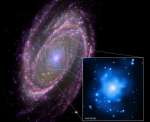 M81: Feeding a Black Hole
27.06.2008
This impressive color composite shows spiral galaxy M81 across the electromagnetic spectrum. It combines X-ray data (blue) from the Chandra Observatory, infrared data (pink) from the Spitzer Space Telescope, and an ultraviolet image (purple) from the GALEX satellite, with a visible light (green) Hubble image.
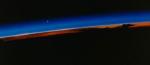 Venus On The Horizon
14.10.1997
The month of October features a sky full of planets, including Venus as the brilliant evening star. Besides the sun and moon, Venus is the brightest object visible in Earth's sky. This month, Venus appears in early evening near the red planet Mars and Mars' red giant rival Antares above the southwestern horizon.
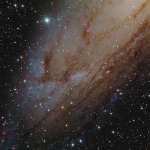 NGC 206 and the Star Clouds of Andromeda
24.10.2012
The large stellar association cataloged as NGC 206 is nestled within the dusty arms of neighboring spiral galaxy Andromeda (M31), 2.5 million light-years distant. Seen near the center of this gorgeous close-up of the southwestern extent of Andromeda's disk, the bright, blue stars of NGC 206 indicate its youth.
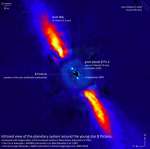 A Giant Planet for Beta Pic
3.07.2010
A mere 50 light-years away, young star Beta Pictoris became one of the most important stars in the sky in the early 1980s. Satellite and ground-based telescopic observations revealed the presence of a surrounding...
 Titan s X Ray
29.04.2004
This June's rare and much heralded transit of Venus will feature our currently brilliant evening star in silhouette, as the inner planet glides across the face of the Sun. But on January 5, 2003 and even rarer transit took place.
 Central Lagoon in Infrared
19.03.2021
Stars fill this infrared view, spanning 4 light-years across the center of the Lagoon Nebula. Visible light images show the glowing gas and obscuring dust clouds that dominate the scene. But this infrared image...
 The Great Orion Nebula M42
4.11.2015
The Great Nebula in Orion, also known as M42, is one of the most famous nebulas in the sky. The star forming region's glowing gas clouds and hot young stars are on the right in this sharp and colorful image that includes the bluish reflection nebulae NGC 1977 and friends on the left.
 A Giant Globular Cluster in M31
17.10.1998
This cluster of stars, known as G1, is the brightest globular cluster in the whole Local Group of galaxies. Also called Mayall II, it orbits the center of the largest nearby galaxy: M31. G1 contains over 300,000 stars and is almost as old as the entire universe.
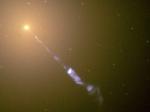 A Jet from Galaxy M87
6.07.2000
What's causing a huge jet to emanate from the center of galaxy M87? Although the unusual jet was first noticed early in the twentieth century, the exact cause is still debated. The above recently released picture taken by the Hubble Space Telescope shows clear details, however.
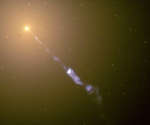 A Jet from Galaxy M87
28.08.2011
What's causing a huge jet to emanate from the center of galaxy M87? Although the unusual jet was first noticed early in the twentieth century, the exact cause is still debated. The above picture taken by the Hubble Space Telescope in 1998 shows clear details, however.
|
January February March April May June July August |
||||||||||||||||||||||||||||||||||||||||||||||||||||||||