
|
You entered: shadow
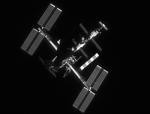 A Visit from Atlantis
28.06.2007
This remarkable image of the space shuttle orbiter Atlantis docked with the International Space Station (ISS) was taken at a range of 190 nautical miles. To record the fast moving pair, last week astronomers...
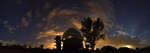 Moon Rays over Byurakan Observatory
26.09.2008
On September 7th, the first quarter Moon and passing clouds contributed to a dramatic night sky over the Byurakan Astrophysical Observatory. This panoramic view begins at the left looking toward the eastern horizon and the rising stars of the constellation Perseus.
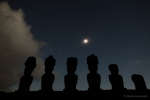 Easter Island Eclipse
14.07.2010
Makemake, a god in Easter Island mythology, may have smiled for a moment as clouds parted long enough to reveal this glimpse of July 11's total solar eclipse to skygazers. In the foreground...
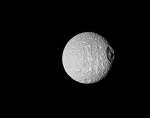 Mimas, Crater, and Mountain
11.01.2017
Mimas is an icy, crater-pocked moon of Saturn a mere 400 kilometers (250 miles) in diameter. Its largest crater Herschel is nearly 140 kilometers wide. About a third the diameter of Mimas itself, Herschel crater gives the small moon an ominous appearance, especially for scifi fans of the Death Star battlestation of Star Wars fame.
 APOD: 2024 November 11 Б The Unusual Tails of Comet Tsuchinshan Atlas
11.11.2024
What created an unusual dark streak in Comet Tsuchinshan-Atlas's tail? Some images of the bright comet during mid-October not only caught its impressively long tail and its thin anti-tail, but a rather unexpected feature: a dark streak in the long tail.
 Enceladus Near Saturn
22.03.2006
Some images of Saturn appear surreal. Earlier this year, the robot spacecraft Cassini now orbiting Saturn took this surreal image of the gas giant Saturn, its majestic rings, and its enigmatic world Enceladus all in one frame.
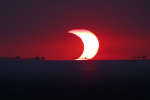 A Partial Eclipse Over Manila Bay
28.01.2009
What's happened to the setting Sun? An eclipse! Two days ago, the Moon eclipsed part of the Sun as visible from parts of Africa, Australia, and Asia. In particular the above image, taken from the Mall of Asia seawall, caught a partially eclipsed Sun setting over Manila Bay in the Philippines.
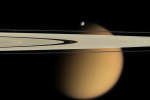 Titan Beyond the Rings
5.05.2009
When orbiting Saturn, be sure to watch for breathtaking superpositions of moons and rings. One such picturesque vista was visible recently to the robot Cassini spacecraft now orbiting Saturn. In 2006 April, Cassini captured Saturn's A and F rings stretching in front of cloud-shrouded Titan.
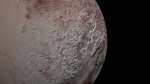 Pluto s Bladed Terrain
5.10.2017
Imaged during the New Horizons spacecraft flyby in July 2015, Pluto's bladed terrain is captured in this close-up of the distant world. The bizarre texture belongs to fields of skyscraper-sized, jagged landforms made almost entirely of methane ice, found at extreme altitudes near Pluto's equator.
 Southern Moonscape
30.08.2024
The Moon's south pole is toward the top left of this detailed telescopic moonscape. Captured on August 23, it looks across the rugged southern lunar highlands. The view's foreshortened perspective heightens the impression of a dense field of craters and makes the craters themselves appear more oval shaped close to the lunar limb.
|
January February March April May June July August September October |
|||||||||||||||||||||||||||||||||||||||||||||||||