
|
You entered: Jupiter
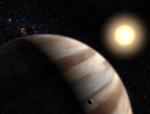 Extra Solar Planetary Atmosphere Detected
28.11.2001
By directly detecting the atmosphere of a planet outside our Solar System, humanity has taken another small step toward finding extraterrestrial life. The unexpected detection by David Charbonneau (Caltech) and associates came from Hubble Space Telescope observations of Sun-like star HD 209458.
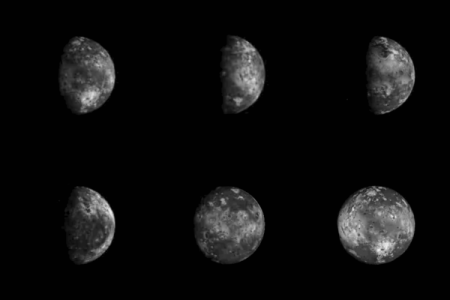 Io Rotating
31.12.1996
Are any volcanoes on Io currently erupting? To help answer this, scientists instructed the robot spacecraft Galileo to take hourly pictures of this moon of Jupiter prior to its most recent encounter. The most obvious changes in Io are due to the changing amount of sunlight reflected from the moon to the spacecraft.
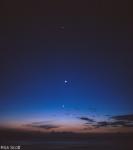 March of the Planets
25.03.1999
This March stargazers have been treated to eye-catching formations of bright planets in western evening skies. On March 3rd, looking toward a beautiful sunset from a beach on the Hawaiian isle of Maui, photographer Rick Scott recorded this fleeting, four-planet "hockey stick" array.
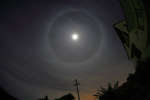 A Halo Around the Moon
20.11.2012
Have you ever seen a halo around the Moon? This fairly common sight occurs when high thin clouds containing millions of tiny ice crystals cover much of the sky. Each ice crystal acts like a miniature lens.
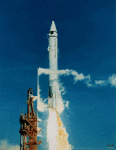 An Atlas Centaur Rocket Launches
14.12.1995
Atlas Centaur rockets have launched over 75 successful unmanned missions. These missions included the Surveyor series - the first vehicles to make soft landings on the Moon, Pioneer 10 and 11 - the first missions...
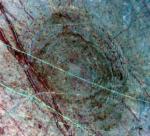 Impact on Europa
15.08.1997
This bull's-eye pattern marks the impact of a mountain-sized comet or asteroid on the icy surface of Jupiter's moon Europa. Recorded by the Galileo spacecraft in April of this year, the composite false color image clearly reveals the telltale concentric fractures which cover about
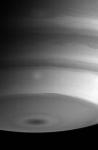 Southern Saturn from Cassini
18.10.2004
What happens to Saturn's pervasive clouds at its South Pole? Visible in the above image of Saturn are bright bands, dark belts and a dark spot right over the South Pole. The above...
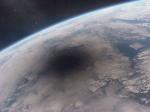 Looking Back at an Eclipsed Earth
10.06.2007
Here is what the Earth looks like during a solar eclipse. The shadow of the Moon can be seen darkening part of Earth. This shadow moved across the Earth at nearly 2000 kilometers per hour.
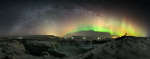 The Waterfall and the World at Night
17.05.2013
Above this boreal landscape, the arc of the Milky Way and shimmering aurorae flow through the night. Like an echo, below them lies Iceland's spectacular Godafoss, the Waterfall of the Gods. Shining just below the Milky Way, bright Jupiter is included in the panoramic nightscape recorded on March 9.
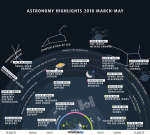 Night Sky Highlights: March to May
14.03.2018
What might you see in the night sky over the next few months? The featured graphic gives a few highlights. Viewed as a clock face centered at the bottom, sky events in March fan out toward the left, April toward the top, and May toward the right.
|
January February March April May June July August September October |
|||||||||||||||||||||||||||||||||||||||||||||||||