
|
You entered: Milky Way
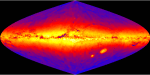 USNO A2.0 Catalog: A Digital Sky
26.04.1999
Here lie 526,230,881 of the brightest stars known. The US Naval Observatory has deployed their monster Precision Measuring Machine to digitize photographic plates covering the whole sky and creating the above map. Yellow corresponds to 150,000 stars per square degree, while dark blue corresponds to only 500 stars per square degree.
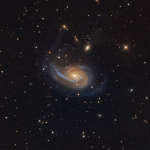 Arp 78: Peculiar Galaxy in Aries
18.09.2020
(xxxedit and linkxxx) Peculiar spiral galaxy Arp 78 is found within the boundaries of the head strong constellation Aries, some 100 million light-years beyond the stars and nebulae of our Milky Way galaxy. Also...
 Stars and Planets over Portugal
18.04.2022
The mission was to document night-flying birds -- but it ended up also documenting a beautiful sky. The featured wide-angle mosaic was taken over the steppe golden fields in Mцrtola, Portugal in 2020. From such a dark location, an immediately-evident breathtaking glow arched over the night sky: the central band of our Milky Way galaxy.
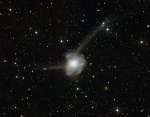 Atoms for Peace Galaxy Collision
16.11.2010
Is this what will become of our Milky Way Galaxy? Perhaps if we collide with the Andromeda Galaxy in a few billion years, it might. Pictured above is NGC 7252, a jumble of stars created by a huge collision between two large galaxies.
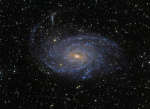 Spiral Galaxy NGC 6744
10.08.2018
Beautiful spiral galaxy NGC 6744 is nearly 175,000 light-years across, larger than our own Milky Way. It lies some 30 million light-years distant in the southern constellation Pavo and appears as only a faint, extended object in small telescopes. We see the disk of the nearby island universe tilted towards our line of sight.
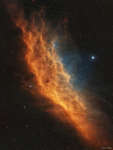 NGC 1499: The California Nebula
6.11.2018
There's even a California in space. Drifting through the Orion Arm of the spiral Milky Way Galaxy, this cosmic cloud by chance echoes the outline of California on the west coast of the United States.
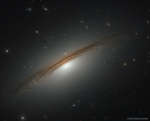 UGC 12591: The Fastest Rotating Galaxy Known
7.03.2017
Why does this galaxy spin so fast? To start, even identifying which type of galaxy UGC 12591 is difficult -- it has dark dust lanes like a spiral galaxy but a large diffuse bulge of stars like a lenticular.
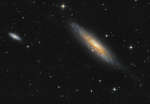 Sculptor Galaxy NGC 134
4.03.2016
NGC 134 is probably not the best known spiral galaxy in the constellation Sculptor. Still, the tantalizing island universe is a clearly a telescopic treasure in southern skies. It shares a bright core, clumpy...
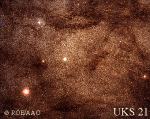 Lensing through Baade's Window
1.02.1996
What is the shape and composition of our Milky Way Galaxy? This question would be easier to answer if there wasn't so much obscuring dust! In the 1940s, however, astronomer Walter Baade identified a "window" near the center of our Galaxy where there is comparatively little opaque dust.
 The Annotated Galactic Center
27.09.2019
The center of our Milky Way galaxy can be found some 26,000 light-years away toward the constellation Sagittarius. Even on a dark night, you can't really see it though. Gaze in that direction, and your sight-line is quickly obscured by intervening interstellar dust.
|
January February March April May June July August September October |
|||||||||||||||||||||||||||||||||||||||||||||||||