
|
You entered: atmosphere
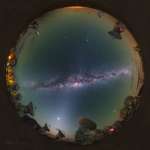 ALMA Milky Way
24.07.2014
This alluring all-skyscape was taken 5,100 meters above sea level, from the Chajnantor Plateau in the Chilean Andes. Viewed through the site's rarefied atmosphere at about 50% sea level pressure, the gorgeous Milky Way stretches through the scene.
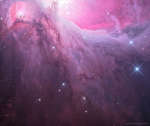 M43: Orion Falls
12.12.2018
Is there a waterfall in Orion? No, but some of the dust in M43 appears similar to a waterfall on Earth. M43, part of the Orion Molecular Cloud Complex, is the often imaged but rarely mentioned neighbor of the more famous M42.
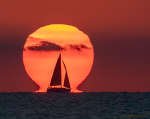 Omega Sunrise
21.09.2020
Capturing this sunrise required both luck and timing. First and foremost, precise timing was needed to capture a sailboat crossing right in front of a rising Sun. Additionally, by a lucky coincidence, the background Sun itself appears unusual -- it looks like the Greek letter Omega (н).
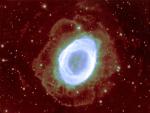 Halos Around the Ring Nebula
22.09.1999
What's happened to the Ring Nebula? The familiar Ring that can be seen with a small back-yard telescope takes on a new look when viewed in dim light. The above recently-released, false-color image...
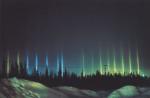 Colorful Light Pillars
2.09.2002
How can an aurora appear so near the ground? Pictured above are not aurora but nearby light pillars, a local phenomenon that can appear as a distant one. In most places on Earth...
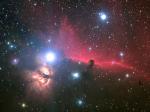 Orions Horsehead Nebula
21.03.2005
The Horsehead Nebula is one of the most famous nebulae on the sky. It is visible as the dark indentation to the red emission nebula seen above and to the right of center in the above photograph. The bright star on the left is located in the belt of the familiar constellation of Orion.
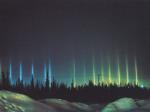 Colorful Light Pillars
5.03.2006
How can an aurora appear so near the ground? Pictured above are not aurora but nearby light pillars, a local phenomenon that can appear as a distant one. In most places on Earth...
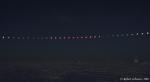 South Pole Lunar Eclipse
7.09.2007
The Moon was up continuously for 14 days in August -- when viewed from the South Pole. But during the total lunar eclipse on August 28, it circled only about 10 degrees above the horizon.
 Noctilucent Cloud Storm Panorama
11.07.2009
Noctilucent or night-shining clouds lie near the edge of space. From about 80 kilometers above Earth's surface, the icy clouds can still reflect sunlight even though the Sun itself is below the horizon as seen from the ground.
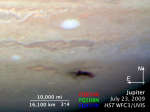 Hubble View: Jupiter Impact
31.07.2009
This sprawling dark marking is Jupiter's latest impact scar, a debris plume created as a small asteroid or comet disintegrated after plunging into the gas giant's atmosphere. Located in Jupiter's south polar region, the new feature was discovered by Australian amateur astronomer Anthony Wesley on July 19.
|
January February March April May June July August September October |
|||||||||||||||||||||||||||||||||||||||||||||||||