
|
You entered: dust cloud
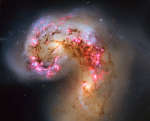 The Antennae Galaxies in Collision
16.03.2014
Two galaxies are squaring off in Corvus and here are the latest pictures. When two galaxies collide, the stars that compose them usually do not. That's because galaxies are mostly empty space and, however bright, stars only take up only a small amount of that space.
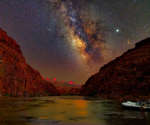 A Sunset Night Sky over the Grand Canyon
4.02.2020
Seeing mountain peaks glow red from inside the Grand Canyon was one of the most incredible sunset experiences of this amateur photographer's life. They appeared even more incredible later, when digitally combined with an exposure of the night sky -- taken by the same camera and from the same location -- an hour later.
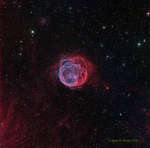 Henize 70: A Superbubble in the LMC
4.02.2019
Massive stars profoundly affect their galactic environments. Churning and mixing interstellar clouds of gas and dust, stars -- most notably those upwards of tens of times the mass of our Sun -- leave their mark on the compositions and locations of future generations of stars.
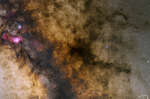 The Central Milky Way from Lagoon to Pipe
1.10.2021
Dark markings and colorful clouds inhabit this stellar landscape. The deep and expansive view spans more than 30 full moons across crowded star fields toward the center of our Milky Way Galaxy. Cataloged in the early 20th century by astronomer E. E.
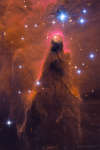 APOD: 2023 January 10 Б NGC 2264: The Cone Nebula
10.01.2023
Stars are forming in the gigantic dust pillar called the Cone Nebula. Cones, pillars, and majestic flowing shapes abound in stellar nurseries where clouds of gas and dust are sculpted by energetic winds from newborn stars. The Cone Nebula, a well-known example, lies within the bright galactic star-forming region NGC 2264.
 APOD: 2024 September 24 Б NGC 6727: The Rampaging Baboon Nebula
24.09.2024
This dusty region is forming stars. Part of a sprawling molecular cloud complex that resembles, to some, a rampaging baboon, the region is a relatively close by 500 light-years away toward the constellation Corona Australis. That's about one third the distance of the more famous stellar nursery known as the Orion Nebula.
 The Great Globular Cluster in Hercules
26.09.2024
In 1716, English astronomer Edmond Halley noted, "This is but a little Patch, but it shows itself to the naked Eye, when the Sky is serene and the Moon absent." Of course...
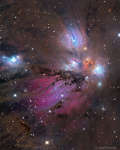 APOD: 2026 May 19 Б NGC 2170: The Angel Nebula
19.05.2026
Is this a painting or a photograph? In this celestial abstract art composed with a cosmic brush, dusty nebula NGC 2170, also known as the Angel Nebula, shines just above the image center. Reflecting...
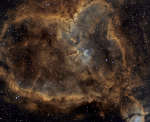 IC 1805: Light from the Heart
14.02.2014
Sprawling across almost 200 light-years, emission nebula IC 1805 is a mix of glowing interstellar gas and dark dust clouds about 7,500 light-years away in the Perseus spiral arm of our galaxy. Stars were born in this region whose nickname, the Heart Nebula, derives from its Valentine's-Day-appropriate shape.
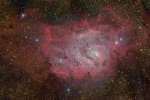 M8: The Lagoon Nebula
17.08.2013
This beautiful cosmic cloud is a popular stop on telescopic tours of the constellation Sagittarius. Eighteenth century cosmic tourist Charles Messier cataloged the bright nebula as M8. Modern day astronomers recognize the Lagoon Nebula as an active stellar nursery about 5,000 light-years distant, in the direction of the center of our Milky Way Galaxy.
|
January February March April May June July August |
||||||||||||||||||||||||||||||||||||||||||||||||||||||||