
|
You entered: water
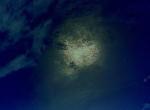 Spiral Eddies On Planet Earth
20.10.1997
Can you identify this stellar nebula? How many light-years from Earth did you say? Looking like a twisting cloud of gas and dust between the stars this wispy nebulosity is actually close by - a spiral eddy formed near the North Atlantic Gulf Stream off the East coast of the US.
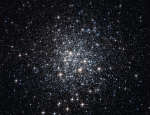 M72: A Globular Cluster of Stars
19.08.2012
Globular clusters once ruled the Milky Way. Back in the old days, back when our Galaxy first formed, perhaps thousands of globular clusters roamed our Galaxy. Today, there are less than 200 left. Many globular clusters were destroyed over the eons by repeated fateful encounters with each other or the Galactic center.
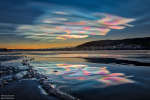 Iridescent Clouds over Sweden
15.01.2020
Why would these clouds multi-colored? A relatively rare phenomenon in clouds known as iridescence can bring up unusual colors vividly or even a whole spectrum of colors simultaneously. These polar stratospheric clouds clouds, also known as nacreous and mother-of-pearl clouds, are formed of small water droplets of nearly uniform size.
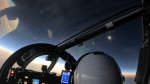 APOD: 2026 September 5 Б Chasing the Moon s Shadow
5.09.2026
Chasing the shadow of a New Moon, NASAБs WB-57F high altitude research aircraft took to the skies off the coast of Iceland on August 12 to observe a total solar eclipse. At 50,000 feet the aircraft was piloted along the precisely determined path of totality to maximize its time in the MoonБs shadow.
 Unexpected X-rays from Comet Hyakutake
11.04.1996
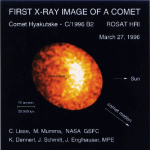
The first X-rays ever detected from a comet were discovered from Comet Hyakutake with the ROSAT satellite on March 27th. The discovery is particularly surprising because there was little previous indication that comets emit any significant X-radiation.
 Springtime on Mars
22.04.2003
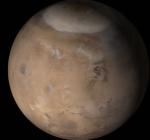
Vast canyons, towering volcanoes, sprawling fields of ice, deep craters, and high clouds can all be seen in this image of the Solar System's fourth planet: Mars. The orbiting robot Mars Global Surveyor spacecraft took the above mosaic of images as springtime dawned in Northern Mars in 2002 May.
 D rad Bacteria: Candidate Astronauts
22.01.2006
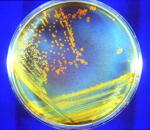
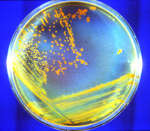
These bacteria could survive on another planet. In an Earth lab, Deinococcus radiodurans (D. rad) survive extreme levels of radiation, extreme temperatures, dehydration, and exposure to genotoxic chemicals. Amazingly, they even have the ability to repair their own DNA, usually with 48 hours. Known as an extremophile, bacteria such as D.
 Enceladus Near Saturn
22.03.2006
Some images of Saturn appear surreal. Earlier this year, the robot spacecraft Cassini now orbiting Saturn took this surreal image of the gas giant Saturn, its majestic rings, and its enigmatic world Enceladus all in one frame.
 Star Cluster Dreams
13.04.2006
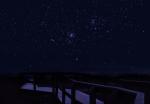
Located some 7,000 light-years away toward the constellation Perseus, this pair of open or galactic star clusters really is visible to the unaided eye and was cataloged in 130 BC by Greek astronomer Hipparchus.
 D. rad Bacteria: Candidate Astronauts
30.08.2009
These bacteria could survive on another planet. In an Earth lab, Deinococcus radiodurans (D. rad) survive extreme levels of radiation, extreme temperatures, dehydration, and exposure to genotoxic chemicals. Amazingly, they even have the ability to repair their own DNA, usually with 48 hours. Known as an extremophile, bacteria such as D.
|
January February March April May June July August September October |
|||||||||||||||||||||||||||||||||||||||||||||||||