
|
You entered: image
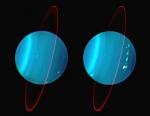 A Sharper View of a Tilted Planet
18.11.2004
These sharp views of tilted gas giant Uranus show dramatic details of the planet's atmosphere and ring system. The remarkable ground-based images were made using a near-infrared camera and the Keck Adaptive Optics system to reduce the blurring effects of Earth's atmosphere.
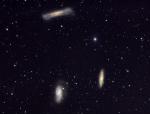 Trio Leo
9.03.2006
This popular group is famous as the Leo Triplet - a gathering of three magnificent galaxies in one field of view. Crowd pleasers when imaged with even modest telescopes, these galaxies can be introduced individually as NGC 3628 (top), M66 (bottom left), and M65 (bottom right). All three are large spiral galaxies.
 Victoria Crater on Mars
2.10.2006
Scroll right to see the largest crater yet visited by a rover on Mars. Reaching the expansive Victoria Crater has been a goal for the robotic Opportunity rover rolling across Mars for the past 21 months. Opportunity reached Victoria last week, and is cautiously probing the stadium-sized crevice.
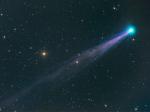 Comet SWAN Brightens
4.10.2006
A newly discovered comet has brightened enough to be visible this week with binoculars. The picturesque comet is already becoming a favored target for northern sky imagers. Pictured above just last week, Comet SWAN showed a bright blue-green coma and an impressive tail.
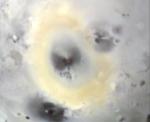 Io Volcano: Pele's Hot Lava
26.11.1999
Glowing hot lava from the heart of Io's volcano Pele is visible in this false-color infrared composite image. It was recorded last month during the Galileo spacecraft's close flyby of the Jovian moon.
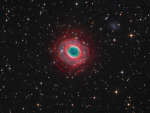 Exploring the Ring
18.09.2008
A familiar sight for northern hemisphere astronomers, the Ring Nebula (M57) is some 2,000 light-years away in the musical constellation Lyra. The central ring is about one light-year across, but this remarkably deep...
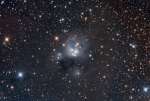 Young Suns of NGC 7129
3.10.2008
Young suns still lie within dusty NGC 7129, some 3,000 light-years away toward the royal constellation Cepheus. While these stars are at a relatively tender age, only about a million years old, it is likely that our own Sun formed in a similar stellar nursery some five billion years ago.
 100 Hours of Astronomy Begins
2.04.2009
Today, 100 Hours of Astronomy begins, a cornerstone project of the International Year of Astronomy 2009 celebrating the 400th anniversary of Gallileo's original telescopic exploration of the sky. Running from April 2 through...
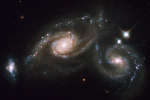 APOD: 2009 April 7 The Colliding Spiral Galaxies of Arp 274
7.04.2009
Two galaxies are squaring off in Virgo and here are the latest pictures. When two galaxies collide, the stars that compose them usually do not. This is because galaxies are mostly empty space and, however bright, stars only take up only a small fraction of that space.
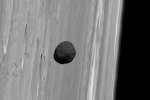 Martian Moon Phobos from Mars Express
1.12.2010
Why is Phobos so dark? Phobos, the largest and innermost of two Martian moons, is the darkest moon in the entire Solar System. Its unusual orbit and color indicate that it may be a captured asteroid composed of a mixture of ice and dark rock.
|
January February March April May June July August September |
|||||||||||||||||||||||||||||||||||||||||||||||||