
|
You entered: star
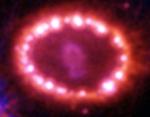 SN1987A s Cosmic Pearls
20.02.2004
In February 1987, light from the brightest stellar explosion seen in modern times reached Earth -- supernova SN1987A. This Hubble Space Telescope image from the sharp Advanced Camera for Surveys taken in November 2003 shows the explosion site over 16 years later.
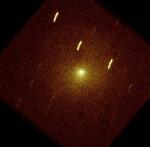 A Swift Look at Tempel 1
3.07.2005
Comet Tempel 1 is targeted for a collision with the impactor probe from NASA's Deep Impact Spacecraft at about 1:52am EDT on July 4th (other time zones). Cameras on the impactor probe...
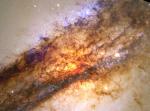 The Center of Centaurus A
17.07.2005
A fantastic jumble of young blue star clusters, gigantic glowing gas clouds, and imposing dark dust lanes surrounds the central region of the active galaxy Centaurus A. This mosaic of Hubble Space Telescope images taken in blue, green, and red light has been processed to present a natural color picture of this cosmic maelstrom.
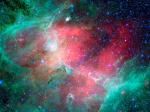 The Eagle Nebula in Infrared
11.01.2007
In visible light, the whole thing looks like an eagle. The region was captured recently in unprecedented detail in infrared light by the robotic orbiting Spitzer Space Telescope (SSC). Shown above, the infrared image...
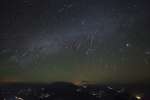 Geminid Meteor Shower over Dashanbao Wetlands
13.12.2013
The annual Geminid meteor shower is raining down on planet Earth this week. And despite the waxing gibbous moonlight, the reliable Geminids should be enjoyable tonight (night of December 13/14) near the shower's peak.
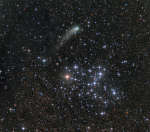 Messier 6 and Comet Siding Spring
17.10.2014
This looks like a near miss but the greenish coma and tail of Comet Siding Spring (C/2013 A1) are really 2,000 light-years or so away from the stars of open cluster Messier 6. They do appear close together though, along the same line-of-sight in this gorgeous October 9th skyscape toward the constellation Scorpius.
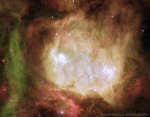 Halloween and the Ghost Head Nebula
30.10.2016
Halloween's origin is ancient and astronomical. Since the fifth century BC, Halloween has been celebrated as a cross-quarter day, a day halfway between an equinox (equal day / equal night) and a solstice (minimum day / maximum night in the northern hemisphere).
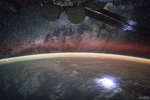 Space Station Vista: Planet and Galaxy
18.01.2017
If you could circle the Earth aboard the International Space Station, what might you see? Some amazing vistas, one of which was captured in this breathtaking picture in mid-2015. First, visible at the top, are parts of the space station itself including solar panels.
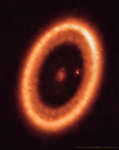 PDS 70: Disk, Planets, and Moons
24.08.2021
It's not the big disk that's attracting the most attention. Although the big planet-forming disk around the star PDS 70 is clearly imaged and itself quite interesting. It's also not the planet on the right, just inside the big disk, thatБs being talked about the most.
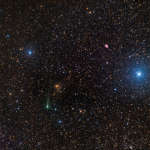 A Comet and a Crab
22.10.2021
This pretty field of view spans over 2 degrees or 4 full moons on the sky, filled with stars toward the constellation Taurus, the Bull. Above and right of center in the frame you can spot the faint fuzzy reddish appearance of Messier 1 (M1), also known as the Crab Nebula.
|
January February March April May June July August September October |
|||||||||||||||||||||||||||||||||||||||||||||||||