
|
You entered: Earth's atmosphere
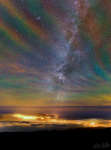 Rainbow Airglow over the Azores
18.04.2021
Why would the sky glow like a giant repeating rainbow? Airglow. Now air glows all of the time, but it is usually hard to see. A disturbance however -- like an approaching storm -- may cause noticeable rippling in the Earth's atmosphere.
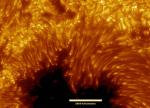 The Sharpest View of the Sun
14.11.2002
This stunning image shows remarkable and mysterious details near the dark central region of a planet-sized sunspot in one of the sharpest views ever of the surface of the Sun. Just released, the picture was made using the Swedish Solar Telescope now in its first year of operation on the Canary Island of La Palma.
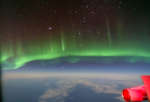 SOFIA s Southern Lights
29.07.2022
SOFIA, the Stratospheric Observatory for Infrared Astronomy, is a Boeing 747SP aircraft modified to carry a large reflecting telescope into the stratosphere. The ability of the airborne facility to climb above about 99 percent of Earth's infrared-blocking atmosphere has allowed researchers to observe from almost anywhere over the planet.
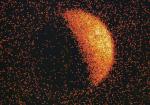 X-Ray Moon
4.10.2003
This x-ray image of the Moon was made by the orbiting ROSAT (Röntgensatellit) Observatory in 1990. In this digital picture, pixel brightness corresponds to x-ray intensity. Consider the image in three parts: the bright hemisphere of the x-ray moon, the darker half of the moon, and the x-ray sky background.
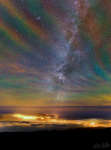 Rainbow Airglow over the Azores
22.03.2016
Why would the sky glow like a giant repeating rainbow? Airglow. Now air glows all of the time, but it is usually hard to see. A disturbance however -- like an approaching storm -- may cause noticeable rippling in the Earth's atmosphere.
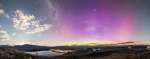 Aurora over New Zealand
26.02.2014
Sometimes the more you look at an image, the more you see. Such may be the case for this beautiful nighttime panorama taken last week in New Zealand. Visible right off, on the far left, are common clouds, slightly altered by the digital fusion of combining 11 separate 20-second exposures.
 APOD: 2025 June 3 Б Rainbow Airglow over the Azores
3.06.2025
Why would the sky glow like a giant repeating rainbow? Airglow. Now, air glows all of the time, but it is usually hard to see. A disturbance however -- like an approaching storm -- may cause noticeable rippling in the Earth's atmosphere.
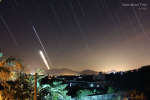 A Fading Moonset Over Hong Kong
15.12.2009
Do stars appear dimmer when nearer the horizon? Yes -- atmospheric air absorbs and reradiates light, so that the greater the airmass through which one peers, the fainter an object will appear. Pictured above in a multi-frame image, stars, the planet Jupiter, and even the Moon show the horizon-dimming effects of Earth's nearly-transparent atmosphere.
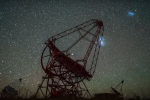 HESS Telescopes Explore the High Energy Sky
8.01.2019
They may look like modern mechanical dinosaurs but they are enormous swiveling eyes that watch the sky. The High Energy Stereoscopic System (H.E.S.S.) Observatory is composed of four 12-meter reflecting-mirror telescopes surrounding a larger telescope housing a 28-meter mirror.
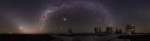 Wonder and Mystery above the Very Large Telescopes
9.05.2011
What's that bright orange dot above the large telescope on the right? Even seasoned sky enthusiasts might ponder the origin of the orange orb seen by scrolling across this panoramic image, taken last December. Perhaps identifying known objects will help.
|
January February March April May June July August September October |
|||||||||||||||||||||||||||||||||||||||||||||||||