
|
You entered: cluster gas
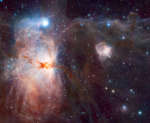 The Flame Nebula in Infrared
12.01.2010
What lights up the Flame Nebula? Fifteen hundred light years away towards the constellation of Orion lies a nebula which, from its glow and dark dust lanes, appears, on the left, like a billowing fire. But fire, the rapid acquisition of oxygen, is not what makes this Flame glow.
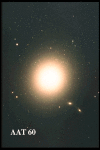 Elliptical Galaxy M87
13.09.1995
Elliptical galaxy M87 is a type of galaxy that looks much different than our own Milky Way Galaxy. But even for an elliptical galaxy M87 is peculiar. M87 is much bigger than an average...
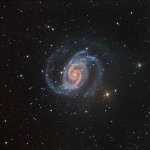 NGC 1566: The Spanish Dancer Spiral Galaxy
14.01.2022
An island universe of billions of stars, NGC 1566 lies about 60 million light-years away in the southern constellation Dorado. Popularly known as the Spanish Dancer galaxy, it's seen face-on from our Milky Way perspective.
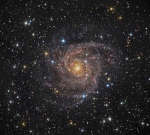 Hidden Galaxy IC 342
22.12.2010
Similar in size to other large, bright spiral galaxies, IC 342 is a mere 7 million light-years distant in the long-necked, northern constellation Camelopardalis. A sprawling island universe, IC 342 would otherwise...
 Hidden Galaxy IC 342
5.10.2006
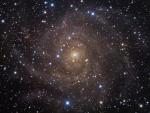
Similar in size to other large, bright spiral galaxies IC 342 is a mere 7 million light-years distant in the long-necked, northern constellation Camelopardalis. A sprawling island universe, IC 342 would otherwise...
 Elliptical Galaxy M87
16.06.2004
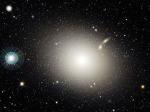
Elliptical galaxy M87 is a type of galaxy that looks much different than our own Milky Way Galaxy. Even for an elliptical galaxy, though, M87 is peculiar. M87 is much bigger than an average...
 Hidden Galaxy IC 342
8.07.2017
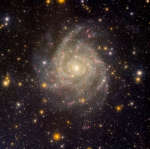
Similar in size to large, bright spiral galaxies in our neighborhood, IC 342 is a mere 10 million light-years distant in the long-necked, northern constellation Camelopardalis. A sprawling island universe, IC 342 would otherwise...
 Stars from Eagle's EGGs
12.04.1998
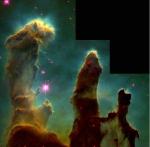
Newborn stars are forming in the Eagle Nebula. This image, taken with the Hubble Space Telescope in 1995, shows evaporating gaseous globules (EGGs) emerging from pillars of molecular hydrogen gas and dust. The giant pillars are light years in length and are so dense that interior gas contracts gravitationally to form stars.
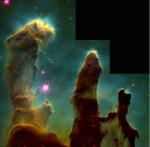 Stars from Eagles Eggs
2.05.1999
Newborn stars are forming in the Eagle Nebula. This image, taken with the Hubble Space Telescope in 1995, shows evaporating gaseous globules (EGGs) emerging from pillars of molecular hydrogen gas and dust. The giant pillars are light years in length and are so dense that interior gas contracts gravitationally to form stars.
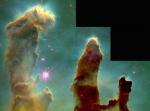 M16: Stars from Eagle's EGGs
25.11.2001
Newborn stars are forming in the Eagle Nebula. This image, taken with the Hubble Space Telescope in 1995, shows evaporating gaseous globules (EGGs) emerging from pillars of molecular hydrogen gas and dust. The giant pillars are light years in length and are so dense that interior gas contracts gravitationally to form stars.
|
January February March April May June July August |
||||||||||||||||||||||||||||||||||||||||||||||||||||||||