
|
You entered: dust lanes
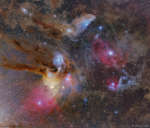 Rho Ophiuchi Wide Field
13.05.2019
The colorful clouds surrounding the star system Rho Ophiuchi compose one of the closest star forming regions. Rho Ophiuchi itself is a binary star system visible in the blue reflection nebula just to the left of the image center.
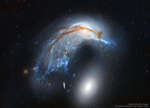 The Porpoise Galaxy from Hubble
6.02.2017
What's happening to this spiral galaxy? Just a few hundred million years ago, NGC 2936, the upper of the two large galaxies shown, was likely a normal spiral galaxy -- spinning, creating stars -- and minding its own business.
 M51 in 255 Hours
11.08.2023
An intriguing pair of interacting galaxies, M51 is the 51st entry in Charles Messier's famous catalog. Perhaps the original spiral nebula, the large galaxy with whirlpool-like spiral structure seen nearly face-on is also cataloged as NGC 5194. Its spiral arms and dust lanes sweep in front of a companion galaxy (right), NGC 5195.
 M83: The Southern Pinwheel
16.01.2025
Beautiful and bright spiral galaxy M83 lies a some twelve million light-years away, near the southeastern tip of the very long constellation Hydra. Prominent spiral arms traced by dark dust lanes and blue star clusters lend this galaxy its popular name, The Southern Pinwheel.
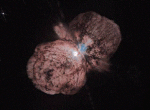 Doomed Star Eta Carinae
16.08.1998
Eta Carinae may be about to explode. But no one knows when - it may be next year, it may be one million years from now. Eta Carinae's mass - about 100 times greater than our Sun - makes it an excellent candidate for a full blown supernova.
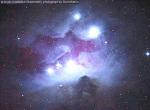 NGC 1977: Blue Reflection Nebula in Orion
22.07.2001
The Orion Nebula is visible to the unaided eye as a fuzzy patch near the famous belt of three stars in the Orion. The above picture captures a part of the Orion Nebula that primarily reflects light from bright Orion stars.
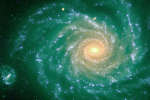 Grand Spiral Galaxy NGC 1232
24.08.2008
Galaxies are fascinating not only for what is visible, but for what is invisible. Grand spiral galaxy NGC 1232, captured in detail by one of the new Very Large Telescopes, is a good example.
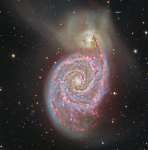 Hydrogen in M51
11.06.2010
Perhaps the original spiral nebula, M51 is a large galaxy, over 60,000 light-years across, with a readily apparent spiral structure. Also cataloged as NGC 5194, M51 is a part of a well-known interacting galaxy pair, its spiral arms and dust lanes clearly sweeping in front of companion galaxy NGC 5195 (top).
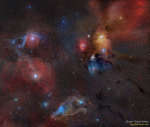 Rho Ophiuchi Wide Field
27.07.2014
The clouds surrounding the star system Rho Ophiuchi compose one of the closest star forming regions. Rho Ophiuchi itself is a binary star system visible in the light-colored region on the image right.
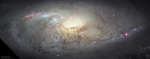 M106 Close Up
3.05.2012
Close to the Great Bear (Ursa Major) and surrounded by the stars of the Hunting Dogs (Canes Venatici), this celestial wonder was discovered in 1781 by the metric French astronomer Pierre Mechain. Later, it was added to the catalog of his friend and colleague Charles Messier as M106.
|
January February March April May June July August September |
|||||||||||||||||||||||||||||||||||||||||||||||||