
|
You entered: emission nebula
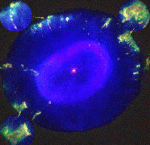 Fliers Around the Blue Snowball Nebula
22.11.1996
Planetary nebulae are strange. First, they are gas clouds and have nothing to do with our Solar System's planets. Next, although hundreds of planetary nebulae have been catalogued and thousands surely exist in our Galaxy, aspects of the formation process are still debated.
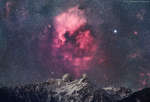 North American Nightscape
29.01.2021
On January 21, light from the Moon near first quarter illuminated the foreground in this snowy mountain and night scene. Known as The Lions, the striking pair of mountain peaks are north of Vancouver, British Colombia, Canada, North America, planet Earth.
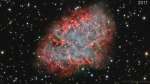 M1: The Incredible Expanding Crab
4.01.2018
The Crab Nebula is cataloged as M1, the first on Charles Messier's famous list of things which are not comets. In fact, the Crab is now known to be a supernova remnant, an expanding cloud of debris from the explosion of a massive star.
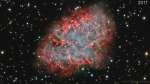 M1: The Incredible Expanding Crab Nebula
19.01.2020
Are your eyes good enough to see the Crab Nebula expand? The Crab Nebula is cataloged as M1, the first on Charles Messier's famous list of things which are not comets. In fact...
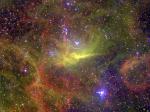 Nebulas Surrounding Wolf Rayet Binary
BAT99 49
Nebulas Surrounding Wolf Rayet Binary
BAT99 49
21.04.2004
How could two young stars power these colorful interstellar gas clouds? Although hidden by thick dust, the stars spew forceful ions and energetic radiation that cause the clouds to fragment and light up.
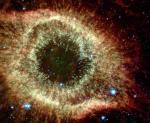 Infrared Helix
12.01.2006
Over six hundred light years from Earth, in the constellation Aquarius, a sun-like star is dying. Its last few thousand years have produced the Helix Nebula (NGC 7293), a well studied and nearby example of a Planetary Nebula, typical of this final phase of stellar evolution.
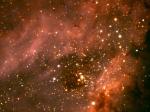 Composing the Omega Nebula
11.12.2000
The Omega Nebula is a massive, complex cloud of dust and gas from which new stars are continually forming. The similarity to the Greek letter capital Omega gives the molecular cloud its popular name, but the nebula is also known as the Swan Nebula, the Horseshoe Nebula, and M17.
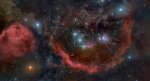 Orion: Head to Toe
23.10.2010
Cradled in cosmic dust and glowing hydrogen, stellar nurseries in Orion the Hunter lie at the edge of a giant molecular cloud some 1,500 light-years away. Spanning nearly 25 degrees, this breath-taking vista stretches across the well-known constellation from head to toe (left to right).
 Official Star Names for Orion
4.12.2016
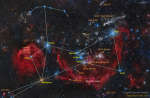
Familiar stars in Orion and constellations across the sky now have official names. Over the past year, the International Astronomical Union, the only body officially tasked with naming stars, approved names already in common use for 227 of the brightest stars, including the most famous stars on the sky Sirius, Polaris, and Betelgeuse.
 The Clouds of Orion the Hunter
15.03.2015
Cradled in cosmic dust and glowing hydrogen, stellar nurseries in Orion the Hunter lie at the edge of giant molecular clouds some 1,500 light-years away. Spanning about 30 degrees, this breath-taking vista stretches across the well-known constellation from head to toe (left to right) and beyond.
|
January February March April May June July August September October |
|||||||||||||||||||||||||||||||||||||||||||||||||