
|
You entered: hot gas
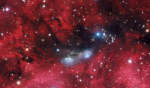 The NGC 6914 Complex
30.08.2018
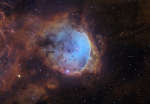
A study in contrasts, this colorful skyscape features stars, dust, and glowing gas in the vicinity of NGC 6914. The complex of reflection nebulae lies some 6,000 light-years away, toward the high-flying northern constellation Cygnus and the plane of our Milky Way Galaxy.
 APOD: 2025 September 19 Б The NGC 6914 Complex
19.09.2025
A study in contrasts, this colorful cosmic skyscape features stars, dust, and glowing gas in the vicinity of NGC 6914. The interstellar complex of nebulae lies some 6,000 light-years away, toward the high-flying northern constellation Cygnus and the plane of our Milky Way Galaxy.
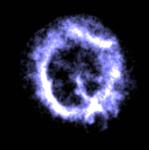 X-ray Hot Supernova Remnant in the SMC
9.12.1999
The Q-shaped cloud seen in this false-color X-ray image from the orbiting Chandra Observatory is big ... about 40 light-years across. It's hot too, as its X-ray glow is produced by multi-million degree gas.
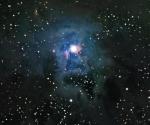 NGC 7023: The Iris Nebula
14.12.2001
Like delicate cosmic petals, these clouds of interstellar dust and gas have blossomed 1,300 light-years away in the fertile star fields of the constellation Cepheus. Sometimes called the Iris Nebula and dutifully cataloged as NGC 7023, this is not the only nebula in the sky to evoke the imagery of flowers.
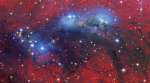 NGC 6914 Nebulae
4.03.2011
A dramatic study in contrasts, this colorful skyscape features stars, dust, and glowing gas in NGC 6914. The complex of nebulae lies some 6,000 light-years away, toward the high-flying northern constellation Cygnus and the plane of our Milky Way Galaxy.
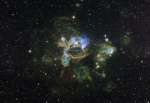 The N44 Complex
27.03.2008
A truly giant complex of emission nebulae, N44 is about 1,000 light-years across. It shines in southern skies as a denizen of our neighboring galaxy, the Large Magellanic Cloud, 170,000 light-years away.
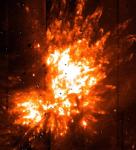 The Kleinmann Low Nebula
2.03.1999
The most active part of the Orion Nebular Cloud Complex is an area known as the Kleinmann-Low Nebula. There, a cluster of young and forming stars is embedded in a molecular cloud filled with dust.
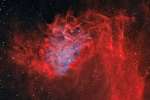 AE Aurigae and the Flaming Star Nebula
11.03.2011
AE Aurigae is the bright star below and left of center in this evocative portrait of IC 405, also known as the Flaming Star Nebula. Embedded in the cosmic cloud, the hot, variable O-type star energizes the glow of hydrogen along convoluted filaments of atomic gas, its blue starlight scattered by interstellar dust.
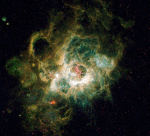 NGC 604: Giant Stellar Nursery in M33
16.08.1996
The nebula cataloged as NGC 604 is a giant star forming region, 1500 light years across, in the nearby spiral galaxy, M33. Seen here in a snapshot by the Hubble Space Telescope, over 200 newly formed, hot, massive, stars are scattered within a cavern-like, gaseous, interstellar cloud.
 NGC 3324 in Carina
6.04.2018
This bright cosmic cloud was sculpted by stellar winds and radiation from the hot young stars of open cluster NGC 3324. With dust clouds in silhouette against its glowing atomic gas, the pocket-shaped star-forming region actually spans about 35 light-years. It lies some 7,500 light-years away toward the nebula rich southern constellation Carina.
|
January February March April May June July August |
||||||||||||||||||||||||||||||||||||||||||||||||||||||||