
|
You entered: phases
 APOD: 2024 February 12 Б HFG1 & Abell 6: Planetary Nebulae
12.02.2024
Planetary nebulae like Heckathorn-Fesen-Gull 1 (HFG1) and Abell 6 in the constellation Cassiopeia are remnants from the last phase of a medium sized star like our Sun. In spite of their shapes, planetary nebulae have nothing in common with actual planets.
 Phi Persei: Double Star
12.12.1997
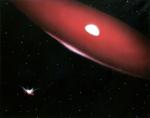
It's clear who is the biggest star in this binary system. Based on recent results, this artist's vision of the double star Phi Persei, 720 light years away, shows a bright, rapidly rotating massive star surrounded by a disk of gas. A small companion star orbits 100 million miles away.
 Lunar Eclipses
25.04.2013
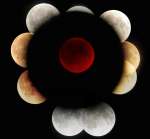
The dark, inner shadow of planet Earth is called the umbra. Shaped like a cone extending into space, it has a circular cross section and is most easily seen during a lunar eclipse. But the complete cross section is larger than the Moon's angular size in the stages of an eclipse.
 Destination: Moon
8.01.1998
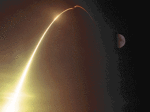
Tuesday, January 6, at 9:28 p.m. EST, NASA's Lunar Prospector spacecraft climbed into the sky above Cape Canaveral Air Station riding an Athena II rocket. Representing NASA's first Moon mission since...
 Supernova Remnant Cassiopeia A
17.01.2025
Massive stars in our Milky Way Galaxy live spectacular lives. Collapsing from vast cosmic clouds, their nuclear furnaces ignite and create heavy elements in their cores. After only a few million years for the most massive stars, the enriched material is blasted back into interstellar space where star formation can begin anew.
 Eclipse Moon Trail
13.10.2000
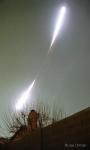
Tonight, Friday the 13th, October's big, bright, beautiful full Moon will be in the sky, rising as the sun sets. A time exposure of this evening's full Moon would show a brilliant circular arc or Moon trail tracing its celestial path.
 M46 and M47: Star Clusters Young and Old
3.04.2012
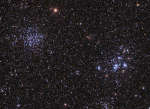
Many stars form in clusters. Galactic or open star clusters are relatively young swarms of bright stars born together near the plane of our Milky Way Galaxy. Separated by about a degree...
 NGC 6164: A Dragon s Egg
24.04.2025
Beautiful emission nebula NGC 6164 was created by a rare, hot, luminous O-type star, some 40 times as massive as the Sun. Seen at the center of the cosmic cloud, the star is a mere 3 to 4 million years old.
 Supernova Remnant Cassiopeia A
6.02.2026
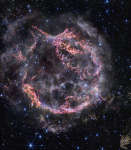
Massive stars in our Milky Way Galaxy live spectacular lives. Collapsing from vast cosmic clouds, their nuclear furnaces ignite and create heavy elements in their cores. After only a few million years for the most massive stars, the enriched material is blasted back into interstellar space where star formation can begin anew.
 Phi Persei: Double Star
2.10.1999
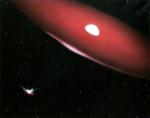
It's clear who is the biggest star in this binary system. Based on recent results, this artist's vision of the double star Phi Persei, 720 light years away, shows a bright, rapidly rotating massive star surrounded by a disk of gas. A small companion star orbits 100 million miles away.
|
January February March April May June July August September |
|||||||||||||||||||||||||||||||||||||||||||||||||