
|
You entered: image
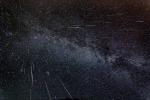 Raining Perseids
12.08.2007
Tonight is a good night to see meteors. Comet dust will rain down on planet Earth, streaking through dark skies in the annual Perseid meteor shower. While enjoying the anticipated space weather, astronomer Fred...
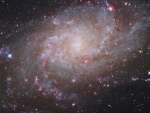 M33: Triangulum Galaxy
13.09.2008
The small, northern constellation Triangulum harbors this magnificent face-on spiral galaxy, M33. Its popular names include the Pinwheel Galaxy or just the Triangulum Galaxy. M33 is over 50,000 light-years in diameter, third largest in the Local Group of galaxies after the Andromeda Galaxy (M31), and our own Milky Way.
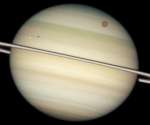 Saturn: Moons in Transit
18.03.2009
Every 14 to 15 years, Saturn's rings are tilted edge-on to our line of sight. As the bright, beautiful rings seem to grow narrower it becomes increasingly difficult to see them, even with large telescopes. But it does provide the opportunity to watch multiple transits of Saturn's moons.
 JWST: Mirrors and Masked Men
11.03.2010
Who are these masked men? Technicians from Ball Aerospace and NASA at Marshall Space Flight Center's X-ray and Cryogenic Facility, of course, testing primary mirror segments of the James Webb Space Telescope (JWST).
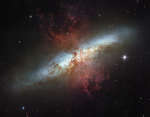 M82: Galaxy with a Supergalactic Wind
18.12.2010
What's lighting up the Cigar Galaxy? M82, as this irregular galaxy is also known, was stirred up by a recent pass near large spiral galaxy M81. This doesn't fully explain the source of the red-glowing outwardly expanding gas, however.
 A Tale of Two Hemispheres
30.07.2011
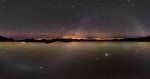
A quest to find planet Earth's darkest night skies led to this intriguing panorama. In projection, the mosaic view sandwiches the horizons visible in all-sky images taken from the northern hemisphere's Canary Island of La Palma (top) and the south's high Atacama Desert between the two hemispheres of the Milky Way Galaxy.
 Cocoon Nebula Wide Field
29.09.2011
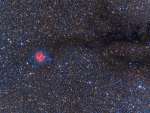
In this crowded starfield spanning some 3 degrees within the high flying constellation Cygnus, the eye is drawn to the Cocoon Nebula. A compact star forming region, the cosmic Cocoon punctuates a long trail of obscuring interstellar dust clouds.
 Geostationary Highway through Orion
15.01.2017
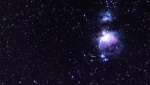
Put a satellite in a circular orbit about 42,000 kilometers from the center of the Earth and it will orbit once in 24 hours. Because that matches Earth's rotation period, it is known as a geosynchronous orbit.
 Cassinis Grand Finale Tour at Saturn
24.01.2017
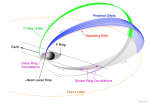
Cassini is being prepared to dive into Saturn. The robotic spacecraft that has been orbiting and exploring Saturn for over a decade will end its mission in September with a spectacular atmospheric plunge. Pictured here is a diagram of Cassini's remaining orbits, each taking about one week.
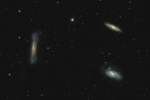 Leo Trio
11.04.2017
This group is popular in the northern spring. Famous as the Leo Triplet, the three magnificent galaxies gather in one field of view. Crowd pleasers when imaged with even modest telescopes, they can be introduced individually as NGC 3628 (left), M66 (bottom right), and M65 (top).
|
January February March April May June July August September |
|||||||||||||||||||||||||||||||||||||||||||||||||