
|
You entered: Earth's atmosphere
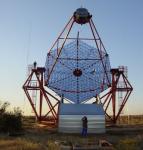 HESS Gamma Ray Telescope
6.09.2002
Most ground-based telescopes with lenses and mirrors are hindered by the Earth's nurturing, protective atmosphere that blurs images and scatters and absorbs light. But this telescope was designed to detect extreme gamma rays - photons with over 100 billion times the energy of visible light - and actually requires the atmosphere to operate.
 APOD: 2023 September 6 Б HESS Telescopes Explore the High Energy Sky
6.09.2023
They may look like modern mechanical dinosaurs, but they are enormous swiveling eyes that watch the sky. The High Energy Stereoscopic System (H.E.S.S.) Observatory is composed of four 12-meter reflecting-mirror telescopes surrounding a larger telescope housing a 28-meter mirror.
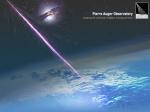 Cosmic Rays from Galactic Centers
12.11.2007
Where do cosmic rays come from? A major step toward answering this century old question may have just come in from the Auger Observatory project, the world's premier cosmic ray observatory. That high energy fundamental particles are barreling through the universe has been known for about a century.
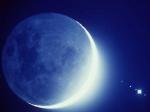 Tonight: A Blue Moon
31.07.2004
How often does a full moon occur twice in a single month? Exactly once in a Blue Moon. In fact, the modern usage of the term "Blue Moon" refers to the second Full Moon in a single month. Tonight's Blue Moon will be the first since November 2001.
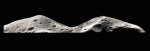 NEAR to an Asteroid
15.02.1996
Excitement mounts as NASA's Near Earth Asteroid Rendezvous (NEAR) spacecraft nears launch - currently scheduled for 3:53 ET on February 16. NEAR's mission is to become the first spacecraft to rendezvous with and orbit an asteroid, the asteroid designated 433 Eros.
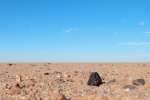 Almahata Sitta 15
28.03.2009
Small asteroid 2008 TC3 fell to Earth at dawn on October 7, 2008, tracking through the skies over the Nubian Desert in northern Sudan. That event was remarkable because it was the first time an asteroid was detected in space before crashing into planet Earth's atmosphere.
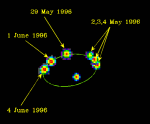 Mizar Binary Star
19.02.1997
Mizar (sounds like "My Czar") is a binary star. In fact, most stars are binary stars. In a binary star system, each star of the pair follows an elliptical orbital path. Mutual gravity causes...
 High Energy Stereoscopic System II
27.07.2012
The largest of its kind, the High Energy Stereoscopic System (H.E.S.S.) II telescope stands in the foreground of this photo. Tilted horizontally it reflects the inverted landscape of the Namibian desert in a segmented mirror 24 meters wide and 32 meters tall, equal in area to two tennis courts.
 A World Explorer
25.08.1995
Ferdinand Magellan was a world explorer. Many consider him the greatest navigator of Europe's 16th century age of sea going exploration and credit his expedition with the first circumnavigation of planet Earth. NASA...
 A Perseid Below
9.08.2024
Denizens of planet Earth typically watch meteor showers by looking up. But this remarkable view, captured on August 13, 2011 by astronaut Ron Garan, caught a Perseid meteor by looking down. From Garan...
|
January February March April May June July August September October |
|||||||||||||||||||||||||||||||||||||||||||||||||