
|
You entered: all sky
 A High Energy Fleet
25.05.1997
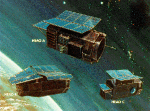
Looking like a fleet of futuristic starcruisers, NASA's highly successful series of High Energy Astrophysical Observatory (HEAO) spacecraft appear poised over planet Earth. Labeled A, B, and C in this vintage illustration, the spacebased telescopes were known as HEAO-1, HEAO-2, and HEAO-3 respectively.
 A High Energy Fleet
24.05.1998
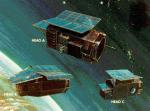
Looking like a fleet of futuristic starcruisers, NASA's highly successful series of High Energy Astrophysical Observatory (HEAO) spacecraft appear poised over planet Earth. Labeled A, B, and C in this vintage illustration, the spacebased telescopes were known as HEAO-1, HEAO-2, and HEAO-3 respectively.
 APOD: 2024 December 8 Б Aurora around Saturns North Pole
8.12.2024
Are Saturn's auroras like Earth's? To help answer this question, the Hubble Space Telescope and the Cassini spacecraft monitored Saturn's North Pole simultaneously during Cassini's final orbits around the gas giant in September 2017. During this time, Saturn's tilt caused its North Pole to be clearly visible from Earth.
 A High Energy Fleet
25.11.2000
Like a fleet of futuristic starcruisers, NASA's highly successful series of High Energy Astrophysical Observatory (HEAO) spacecraft appear poised over planet Earth. Labeled A, B, and C in this vintage illustration, the spacebased telescopes were known as HEAO-1, HEAO-2, and HEAO-3 respectively.
 North Celestial Tree
23.10.2013
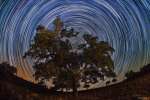
If you climbed this magnificent tree, it looks like you could reach out and touch the North Celestial Pole at the center of all the star trail arcs. The well-composed image was recorded over a period of nearly 2 hours as a series of 30 second long, consecutive exposures on the night of October 5.
 Planets of the Solar System
25.06.2022
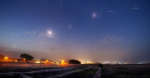
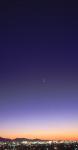
Simultaneous images from four cameras were combined to construct this atmospheric predawn skyscape. The cooperative astro-panorama captures all the planets of the Solar System, just before sunrise on June 24. That foggy morning found innermost planet Mercury close to the horizon but just visible against the twilight, below and left of brilliant Venus.
 A Jupiter Venus Conjunction
8.03.1999
Venus and Jupiter appeared unusually close together in the sky last month. The conjunction was easily visible to the unaided eye because Venus appears brighter than any background star. The two planets were not significantly closer in space - Venus just passed nearly in front of Jupiter as seen from the Earth.
 Simeis 147: Supernova Remnant
25.04.2016
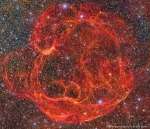
It's easy to get lost following the intricate strands of the Spaghetti Nebula. A supernova remnant cataloged as Simeis 147 and Sh2-240, the glowing gas filaments cover nearly 3 degrees -- 6 full moons -- on the sky. That's about 150 light-years at the stellar debris cloud's estimated distance of 3,000 light-years.
 Simeis 147: Supernova Remnant
18.05.2017
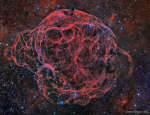
It's easy to get lost following intricate filaments in this detailed image of faint supernova remnant Simeis 147. Also cataloged as Sharpless 2-240 it goes by the popular nickname, the Spaghetti Nebula. Seen toward the boundary of the constellations Taurus and Auriga, it covers nearly 3 degrees or 6 full moons on the sky.
 Six Worlds for Kepler 11
3.02.2011
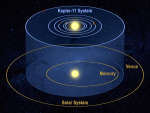
Six worlds orbit Kepler-11, a sunlike star 2,000 light-years distant in the constellation Cygnus. The new discovery, based on data from NASA's planet hunting Kepler spacecraft, makes the Kepler-11 system the fullest exoplanetary system known.
|
January February March April May June July August September October |
|||||||||||||||||||||||||||||||||||||||||||||||||