
|
You entered: full moon
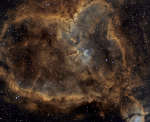 IC 1805: Light from the Heart
14.02.2014
Sprawling across almost 200 light-years, emission nebula IC 1805 is a mix of glowing interstellar gas and dark dust clouds about 7,500 light-years away in the Perseus spiral arm of our galaxy. Stars were born in this region whose nickname, the Heart Nebula, derives from its Valentine's-Day-appropriate shape.
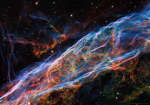 Veil Nebula: Wisps of an Exploded Star
5.04.2021
Wisps like this are all that remain visible of a Milky Way star. About 7,000 years ago that star exploded in a supernova leaving the Veil Nebula. At the time, the expanding cloud was likely as bright as a crescent Moon, remaining visible for weeks to people living at the dawn of recorded history.
 Elephant s Trunk and Caravan
8.06.2023
Like an illustration in a galactic Just So Story, the Elephant's Trunk Nebula winds through the emission region and young star cluster complex IC 1396, in the high and far off constellation of Cepheus. Seen on the left the cosmic elephant's trunk, also known as vdB 142, is over 20 light-years long.
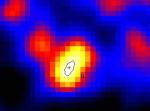 The Case of the Missing Supernova
13.04.1999
Would you notice a second Moon in the sky? About 700 years ago, light from a tremendous explosion reached Earth that should have appeared almost as bright as a full Moon. The bright spot should have lasted for weeks, yet no notation of such an occurrence has been found in historical records.
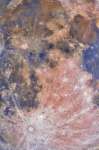 A Colorful Moon
19.12.2013
The Moon is normally seen in subtle shades of grey or yellow. But small, measurable color differences have been greatly exaggerated to make this telescopic, multicolored, moonscape captured during the Moon's full phase. The different colors are recognized to correspond to real differences in the chemical makeup of the lunar surface.
 Odysseus and The Dish
1.03.2024
Murriyang, the CSIROБs Parkes radio telescope points toward a nearly Full Moon in this image from New South Wales, Australia, planet Earth. Bathed in moonlight, the 64 meter dish is receiving weak radio signals from Odysseus, following the robotic lander's February 22 touch down some 300 kilometers north of the Moon's south pole.
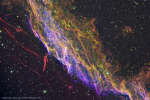 NGC 6992: Filaments of the Veil Nebula
1.12.2009
Wisps like this are all that remain visible of a Milky Way star. About 7,500 years ago that star exploded in a supernova leaving the Veil Nebula, also known as the Cygnus Loop.
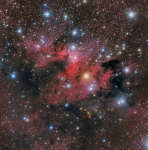 The Light, the Dark, and the Dusty
5.03.2020
This colorful skyscape spans about four full moons across nebula rich starfields along the plane of our Milky Way Galaxy in the royal northern constellation Cepheus. Near the edge of the region's massive...
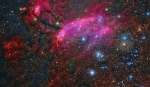 IC 4628: The Prawn Nebula
9.12.2016
South of Antares, in the tail of the nebula-rich constellation Scorpius, lies emission nebula IC 4628. Nearby hot, massive stars, millions of years young, irradiate the nebula with invisible ultraviolet light, stripping electrons from atoms. The electrons eventually recombine with the atoms to produce the visible nebular glow, dominated by the red emission of hydrogen.
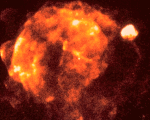 Vela Supernova Remnant in X-ray
12.06.1996
What happens when a star explodes? A huge fireball of hot gas shoots out in all directions. When this gas slams into the existing interstellar medium, it heats up so much it glows in X-rays.
|
January February March April May June July August September October |
|||||||||||||||||||||||||||||||||||||||||||||||||