
|
You entered: hot star
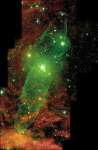 Ou4: A Giant Squid Nebula
18.07.2014
A mysterious, squid-like apparition, this nebula is very faint, but also very large in planet Earth's sky. In the mosaic image, composed with narrowband data from the 2.5 meter Isaac Newton Telescope, it spans some 2.5 full moons toward the constellation Cepheus.
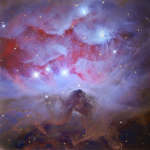 Reflections on the 1970s
13.01.2016
The 1970s are sometimes ignored by astronomers, like this beautiful grouping of reflection nebulae in Orion - NGC 1977, NGC 1975, and NGC 1973 - usually overlooked in favor of the substantial glow from the nearby stellar nursery better known as the Orion Nebula.
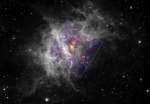 Young Star Cluster Westerlund 2
26.06.2010
Dusty stellar nursery RCW 49 surrounds young star cluster Westerlund 2 in this remarkable composite skyscape from beyond the visible spectrum of light. Infrared data from the Spitzer Space Telescope is shown in black...
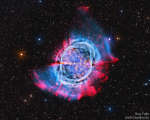 M27: The Dumbbell Nebula
12.07.2021
What will become of our Sun? The first hint of our Sun's future was discovered inadvertently in 1764. At that time, Charles Messier was compiling a list of diffuse objects not to be confused with comets.
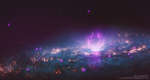 X Ray Superbubbles in Galaxy NGC 3079
5.03.2019
What created these huge galactic superbubbles? Two of these unusual bubbles, each spanning thousands of light-years, were recently discovered near the center of spiral galaxy NGC 3079. The superbubbles, shown in purple on the image right, are so hot they emit X-rays detected by NASA's Earth-orbiting Chandra X-Ray Observatory.
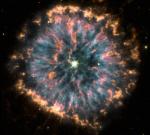 Celebrating Hubble With NGC 6751
16.04.2005
Planetary nebulae can look simple, round, and planet-like in small telescopes. But images from the orbiting Hubble Space Telescope have become well known for showing these fluorescent gas shrouds of dying Sun-like stars to possess a staggering variety of detailed symmetries and shapes.
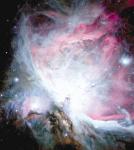 The Orion Nebula from CFHT
15.03.2004
Few astronomical sights excite the imagination like the nearby stellar nursery known as the Orion Nebula. The Nebula's glowing gas surrounds hot young stars at the edge of an immense interstellar molecular cloud only 1500 light-years away.
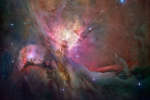 Orion Nebula: The Hubble View
22.02.2009
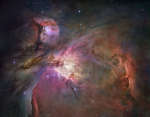
Few cosmic vistas excite the imagination like the Orion Nebula. Also known as M42, the nebula's glowing gas surrounds hot young stars at the edge of an immense interstellar molecular cloud only 1,500 light-years away.
 Orion Nebula: The Hubble View
15.07.2012
Few cosmic vistas excite the imagination like the Orion Nebula. Also known as M42, the nebula's glowing gas surrounds hot young stars at the edge of an immense interstellar molecular cloud only 1,500 light-years away.
 Twistin' by the Lagoon
23.01.1997
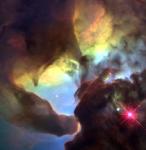
The awesome spectacle of starbirth produces extreme stellar winds and intense energetic starlight -- bombarding dusty molecular clouds inside the Lagoon Nebula (M8). At least two long funnel shaped clouds, each roughly half a light-year long, have apparently been formed by this activity.
|
January February March April May June July |
|||||||||||||||||||||||||||||||||||||||||||||||||